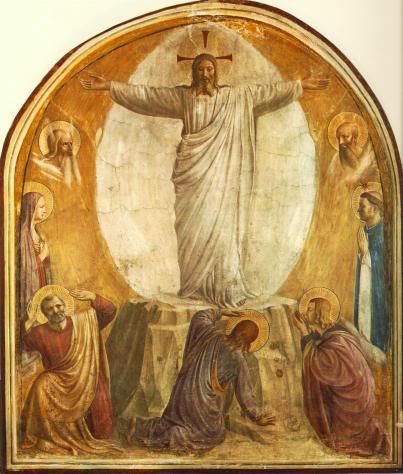
When you call to the Lord
God will listen
When you cry out
God will say
"Here I am."
God will listen
When you cry out
God will say
"Here I am."
(fresco by Fra Angelico, 1436-45, Monastery of San Marco, Florence)
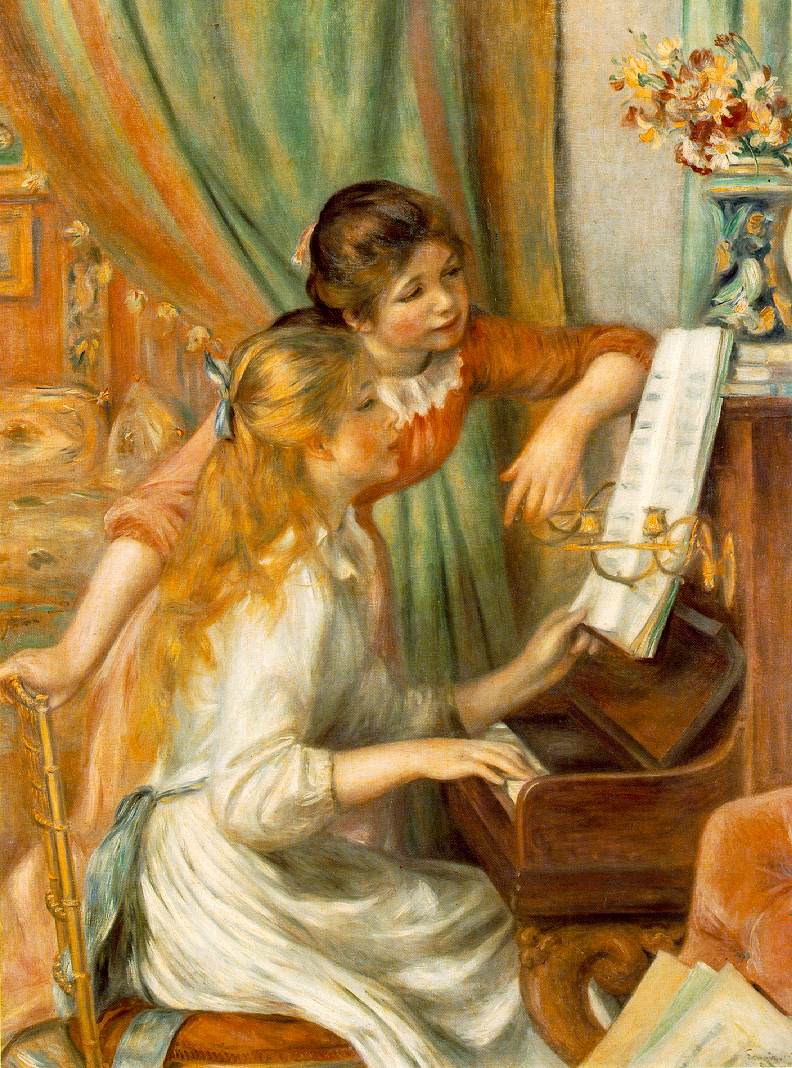

It was my sister, inspired after hearing Natalie Cole’s Our Love, who wanted to learn to tickle and caress the ebonies and ivories herself. After showing sufficient dedication to asking my parents for piano lessons, she got them, and my family got a piano. Thus my fate was sealed: I too was going to have piano lessons one day. I may have wanted them initially, but by the time I started, around the age of 7, I wasn’t as enthused. But my mom never let me quit, partially because we had a piano and someone had to play it, and she was convinced that it would make us better at math. Ha! (My mom gets the last laugh – both my sister and I excel at math and have engineering degrees.)
Thank you, Mrs. Cherry and Mrs. Seagrave, for your dedication.

Thus, I hate you Chopin’s Minute Waltz! (Think about playing the above in an interval of about a second.) It was a year of exquisite torture to learn to play you with modest success, and my dear piano teacher would clock the time it took me to play you. To this day, I can’t hear you on the radio without my right hand starting to tremor from all the “rotate your forearm and loosen your wrist to play the trills, don’t try to do it from your fingers!”
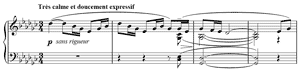 I love you with a love that’s pure and true, Debussy’s Le fille aux cheveux de lin. I loved mastering your chromatics and playing all the black keys. I also loved your dynamics: playing you was like taking a beautiful stroll in the afternoon of a dream world.
 I love you, Bach’s Prelude No. 1 (from the Well-Tempered Clavier). Used in Gounod’s Ave Maria, you are like a lullaby and you were my own favorite to end my practicing sessions. And for your Preludes, Mr. J.S. Bach, I forgive you all your Inventions, played with speed and deliberation in all sorts of keys. I'll even forgive your son.


Empire of the Stars: Obsession, Friendship, and Betrayal in the Quest for Black Holes by Arthur I. Miller (2005)
This largely boringly written book – the best parts are the footnotes that discuss the findings dully presented in the text – chronicles the career of Subrahmanyan Chandrasekhar, who first proposed and calculated that there was an upper limit to the mass of a white dwarf: any white dwarf with a mass of over 1.4 times the solar mass would began a process of collapse that would lead to a singularity, a point of infinite density and zero volume. Chandra presented his findings in 1935, only to be met with harsh resistance, particularly from Arthur Stanley Eddington, then the pre-eminent astrophysicist in the world.Miller tries to make a case that racism played a part in the professional response to Chandra’s calculation; certainly the professional goals of other prominent scientists led to the ignoring of Chandra’s findings, as did presuppositions from well-regarded scientists, like Eddington and Einstein, that the universe would not yield an infinite result. But to me, the story sounds all too typical of academia – the group in power wants results and conclusions that match up to their own way of thinking and are resistant to novelty. What else is new?
Although Chandra undoubtedly felt the condemnation from Eddington and the slighting of his work by his peers for the rest of his life (he was angry that he didn’t win the Nobel Prize twenty years earlier than he did), he went on to make significant findings in other fields away from astronomy, and did not seem to be professionally crippled by the experience, no matter how it wounded him personally.
Of greater interest in the book is the intellectual evolution towards the acceptance of black holes: from the 1935 negative reaction to the 1960s theorizing that indeed, black holes must exist, although evidence of their existence had not been found to date. There’s some cool stuff in this book about the nuclear arms race, hydrogen bombs, and the death of stars, but I really would never have finished this book if I hadn’t been stuck in an airport for 4 hours and wanted to avoid digging through my luggage for another book. It’s not the content, which could be fascinating. It’s the writing, dull as dishwater.
One fine example (pg 178): “Chandra had a keen eye for lurking stability problems; his forte was identifying the exact point at which a star is likely to collapse. He spotted a flaw in Gamow’s argument. The challenge was irresistible, and he decided to turn his attention to white dwarfs one last time.” Absorbing mystery yarn? Action-adventure for the teen-boy crowd? Cliched phrases, Alex, for $600!
Anytime reading the footnotes becomes more engrossing than the actual text, something is wrong. (One of the gems of the footnotes is that there may be white dwarfs that are diamonds, composed entirely of compressed carbon. Another is the story of Fuchs’ espionage.)
So unless anyone wants to know more from me about this book, I’ll put a black hole tutorial in this space.
Classifications of black holes: mass, spin, and magnetic field
Stellar black holes: have a mass of 10-100 times the solar mass.
Supermassive black holes: have a mass of millions to even billions of solar masses.
Schwarzschild black holes: no spin and no magnetic field. It has two main components - a singularity and an event horizon. The singularity is what is left of the collapsed star, and is theoretically a point of 0 dimension with infinite density but finite mass. The event horizon is a region of space that is the "boundary" of the black hole. Within it, the escape velocity is faster than light, so it is past this point that nothing can escape.
Reissner-Nordstrøm Black Holes: no spin and a magnetic field. It has a singularity and two event horizons. The outer event horizon is a boundary where time and space flip. This means that the singularity is no longer a point in space, but one in time. The inner event horizon flips space-time back to normal.
An interesting point that comes up in the case of a spinning black hole is that of the naked singularity. The faster the black hole rotates, the larger the inner event horizon becomes, while the outer event horizon remains the same size. They become the same size when the rotational energy equals the mass energy of the black hole. If the rotational energy were to become more than the mass energy, the event horizons would vanish and what would be left is a "naked singularity" - a black hole whose only part is the singularity.
Yet another distinguishing feature of the Kerr black hole is that, since it rotates, the 0-D point that is the singularity in the Schwarzschild and Reissner-Nordstrøm black hole is spun into a ring of 0 thickness. Interesting theoretical physics can take place around this ring singularity. One consequence is that nothing can actually fall into it unless it approaches along a trajectory along the ring's side. Any other angle and the ring actually produces an antigravity field that repels matter.
NOTE: The only physical part of a black hole is the singularity. The other parts mentioned are mathematical boundaries. There is no physical barrier called an event horizon, but it marks the boundaries between types of space under the influences of the singularity.
Two other features can characterize a black hole: accretion disk and jets.
An accretion disk is matter that is drawn to the black hole. In rotating black holes and/or ones with a magnetic field, the matter forms a disk due to the mechanical forces present. In a Schwarzschild black hole, the matter would be drawn in equally from all directions, and thus would form an omni-directional accretion cloud rather than disk.
The matter in accretion disks is gradually pulled into the black hole. As it gets closer, its speed increases, and it also gains energy. Accretion disks can be heated due to internal friction to temperatures as high as 3 billion K, and emit energetic radiation such as gamma rays. This radiation can be used to "weigh" the black hole. By using the doppler effect astronomers can determine how fast the material is revolving around the black hole, and thus can infer its mass.
A second way for black holes to form is that, in some rare instances, two neutron stars will be locked in a binary relationship. Because of energy lost through gravitational radiation, they will slowly spiral in towards each other, and merge. When they merge, they will almost always form a black hole.
Finally, a third way was proposed by quantum cosmologist Stephen Hawking. He theorized that trillions of black holes were produced in the Big Bang, with some still existing today. This theory is not as widely accepted as the other two.
AG again, providing cool facts about black holes (see Hawking's Brief History of Time or Greene's The Elegant Universe for more):
Black holes aren’t really black. As proposed by Stephen Hawking, black holes emit a type of radiation due to escaping particles. The intense gravitational field near the event horizon of a black hole can briefly split a pair of photons apart. If one falls through the event horizon, the other particle, which would have been annihilated by its partner when they came into contact, is now left outside the black hole; indeed the energy from the fall of the one partner of the pair over the event horizon will give the other partner energy to move further away from the event horizon. The particles emitted from a black hole in this way are called Hawking radiation. Which leads to…
Black holes may evaporate. Although not yet observed, if blacks holes leak energy (through the Hawking radiation) we know from Einstein’s famous E = mc2 that the black hole will also lose mass. However, for a typical black hole, the evaporation time would amount to more than 1067 years (the age of the universe is around 109 years). But lightweight black holes formed in the first few moments of the Big Bang (according to Hawking’s calculations, less mass means higher temperature and hence more radiation) may exist and may be on the verge of evaporation, emitting Hawking radiation and gamma rays that could be picked up by observatories. Even more fascinating: as a black hole emits radiation, its mass shrinks and the distance between its center and the even horizon diminishes. As this happens, does the space that was previously in the black hole still contain its old information? Hawking has bet that black holes destroy the information.
Black holes have entropy. This was actually one of the starting problems that lead to the two solutions described above, formulated in 1974 by Hawking. Starting from these theoretical observations/calculations: the area of the event horizon increases in physical interactions (calculated by Hawking), and black holes must have entropy (Jacob Beckenstein), and with a whole lotta intuition and math, Hawking arrived at the above conclusions.
There may be massless black holes. Formed from a black hole that has lost its mass; these black holes would lack an event horizon. In string theory, the loss of mass is attributable to the shrinking of a piece of the Calabi-Yau portion of space to a point. (Calabi-Yau spaces are where the extra dimensions required by string theory can be curled up.)
And of course, this sci-fi question remains: at the singularity, where space-time is infinitely curved and time ends, could it be possible for another universe to be attached? String theory provides possible solutions, but that’s another discussion.
 Self-Portrait, 1893-4
 Vision After the Sermon, 1888
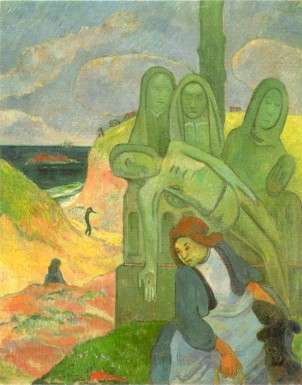 The Green Christ/Breton Calvary, 1889
 D'où venons nous? Que sommes nous? Où allons nous?/Where Do We Come From? What Are We? Where Are We Going?, 1897-98
 Mahana No Atua/ The Day of the God, 1894
In MacMillan’s Romeo and Juliet (music by Prokofiev), at the end of the famous balcony scene where Romeo and Juliet have declared their love, Rudolf Nureyev plants his left foot and stretches his back leg in a long line (fourth position), and from the small of his back, stretches his chest upwards towards Juliet (Margot Fonteyn), giving her his heart. This is the purest demonstration I’ve seen that turnout, one of the hallmarks of Western classical dance, is not just about turning out at the hips so that the feet form a 180 degree line. Turnout is instead a physical and moral commitment to open outwards and upwards from the major vertical axis of the body, straight through one’s head and heart, and reveal the soul. The soul of Nureyev’s Romeo is about two inches outside of his body, drawn towards Juliet as Fonteyn crosses her hands over her heart.
Violette Verdy’s Eurydice and Francisco Moncion’s Orpheus (Balanchine’s Orpheus, music by Stravinsky) move around an identical axis after he’s rescued her from Hades. They do tango steps, legs entwined, and she surrounds him to plead with him to look at her. She wraps her legs entirely around his body – around his waists and thighs, and in a back bend begs. He removes his blindfold, eyes lifted towards heaven, and she collapses dead on the stage.
Spurned by her lover Solor, Altynai Asylmuratova as Nikiya (in La Bayadere, original choreography by Petipa and music by Minkus) turns her back to him, goes on to her knees, extends her left leg behind her, arches her back and cries to the gods, hands clasped above her head.
In Balanchine’s Diamonds pas de deux (music by Tchaikovsky), Suzanne Farrell releases Peter Martins’ hand and balances for a moment on her left leg with her right leg held high (developpe a la seconde). She drops her leg in an arc like the swing of a pendulum, bourrees towards Martins (those tiny steps on pointe – Farrell’s here look like moving ripples in water), does a double inside-out pirouette which blinds her to where Martins actually is, establishing their trusting relationship; she kicks and pauses, her torso bent over an extended leg, creating an image of a unicorn, and instantly tosses her torso and extended leg backwards. Suddenly she is the image of a vulnerable woman, neck and breast exposed, arm behind her in submission, and her leg (in attitude) recreates the lines that form the conch shell, the golden mean. Farrell is the hunted, the hunter (“on the scent of her own mystery” as Croce wrote), and the archetypal woman.
Allegra Kent, in her idiosyncratic reading of the second movement of Balanchine’s Symphony in C (music by Bizet), releases her arms from a circle above her head into the space in front of her as she is spun around – she releases her energy, draws it into herself again, then gives it away once more.
Near the end of Suzanne Farrell’s solo in Der Rosenkavalier Waltz (music by R. Strauss from Balanchine’s Vienna Waltzes), on a dark, empty stage where her imaginary lover has once again disappeared, she rushes to go off stage, pauses, and as she does the famous backbend of supplication, she disappears in the brightness of all the stage lights coming on at once.
A Lenten Reflection
In the second week of Lent, I’m sitting here writing about art, while many, more spiritually-minded, are staying away from these types of self-reflections or reviews. But in my weakness, I need the distraction, the time to pause, from a few other obligations. (Or maybe I’m establishing that I’m really the worst-type of Novus ordo Catholic: Lent, schment.) Excuse my self-justification for indulging this behavior, and you are of course free to stop reading now.
I have loved two particular stories about darkness and mistaken identity since pre-teen days. The first is the Greek myth of Cupid and Psyche, as first encountered in Edith Hamilton’s classic school text Mythology. I was baffled as to how Psyche could not know that Cupid, her husband and lover who came to her only in the darkness, was not some awful serpent who would devour her. After Psyche has betrayed him by gazing upon him as he slept, Cupid delivers a parting line that I loved: “Love cannot live where there is no trust.”
The other story is of that deceiver, Jacob, who uses Isaac’s blindness to receive the blessing meant for his brother, is himself tricked in the dark when he mistakes Leah for Rachel, and wrestles with an angel in the dark. By sunrise he has a new identity as
Of course, darkness has always held great significance – God separates darkness from light; Christ enters a darkened world. The world again darkens at Christ’s death. The womb and the tomb are in darkness. All manner of scary stories are told “in the dark.” To be in the dark is to be uncertain and vulnerable, in a state where people can make and re-make themselves, as with Jacob and Leah and all our legends and fairy tales of people who can shape-shift once the sun goes down. In the dark, one can lose one’s identity, one can be tricked, and one can emerge in the daylight changed.
Far from being in the dark, I’ve always thought of our modern world as glaringly in the light – we may have bad vision, but we certainly have a lot of brightness. There’s almost nothing that can’t be uncovered and dissected and discussed – we hate mystery. Everything needs to be explained and put up for public discussion.
I grew up during the time that sex, at its most technical and mechanical, began to be discussed on shows that even children (such as myself) would commonly watch. This development was at least partly the response to HIV and AIDS, but certain elements of popular culture also took advantage and began to further endorse a hyper-masculine American culture where hyperactive male sexual expression was the only type allowed. Thus, even the most intimate of activities was put under blinding bright light.
An aside: I’ve always thought that the relationship between the main characters, Paul and Jeanne, in Last Tango in Paris would have at least possibly had a chance if they had engaged in at least some of their sexcapades in the dark. Of course, that it seems they never did has its own meaning.
When we look at our culture, it’s like looking in a mirror – not seeing yourself as you are, but seeing yourself looking at yourself. The great thing about art, when it works, is that you don’t experience self-reflection, but a kind of re-making. For purely practical reasons, of course, we usually experience the arts in semi-darkness (except for sculpture and architecture, of course). But in the darkness of a theatre or concert hall or a museum (except for the modern art sections of the museum, haha), where no one can really see you, you have an opportunity for a type of self-emptying to be filled back up with the beauty and mystery that the artist invites you to participate in. In the dark you can’t see your own reflection. You can only experience, and maybe be inspired. Train yourself to do this in the arts enough, and you may find yourself more easily doing it before God.