Wednesday, March 7, 2007

Feast Day of Sts. Perpetua & Felicity


Two of my favorites!
"Stand fast in the faith, and love you all one another."

" O most valiant and blessed martyrs! O truly called and elected unto the glory of Our Lord Jesus Christ! Which glory he that magnifies, honors and adores, ought to read these witnesses likewise, as being no less than the old, unto the Church's edification; that these new wonders also may testify that one and the same Holy Spirit works ever until now, and with Him God the Father Almighty, and His Son Jesus Christ Our Lord,
to Whom is glory and power unending for ever and ever. Amen."

Read St. Perpetua's account here.

Endo's Silence

Silence (1969), a novel by Japanese author Shusaku Endo (1923-1996), confronts several issues: the desperation of man's call to God, the goals of a missionary (noble or self-glorifying), and the ability of Christianity to take root in another culture (in this book, Japan).

It is the story of a Portuguese missionary, Sebastien Rodrigues, idealistic and glory-searching, who goes to Japan in 1640, a time when Christianity has gone underground and Christians are being persecuted. He has the typical visions of glory when administering to the Japanese Christians who are eager to receive the sacraments again, though this begins to fade with the reality of life, and running for his life.

[Note: I'm not well-read on Japanese history but in the preface William Johnston, the translator of Endo's novel, provides a brief history of Christianity's introduction and growth in Japan. St Francis Xavier arrived there in 1549 and would call the Japanese 'the joy of my heart.' By 1614, there were 300,000 Japanese Christians including local clergy. The lack of a strong centralized government had been operative in the spread of Christianity in Japan, and as strong leadership from the shoguns again exerted itself, the Christians began to be persecuted. Initially immediately executing Christians who had been rounded-up, the shoguns realized that making martyrs only strengthened the convictions of the remainder. Thus, they began to precede execution with torture to make the martyrs apostatize, typically by stamping their foot on a picture of Christ. The most famous of these tortures was to hang them down upside in a filthy pit. In 1632, after six hours in the pit, the first missionary apostatized (Christovao Ferreira) and began collaborating with local rulers. The Shimabara Rebellion, originally against policies of local government, became a pro-Christian insurgency that led rulers to suspect aid from outside governments (like Portugal) was involved, and Japan was shut off from Christian missionaries. Nevertheless, as Johnston writes:

"The faith was handed down; baptism was administered; catechism was taught. They gave their names, of course, to the Buddhist temple; they complied with the order to trample on the sacred image; and today at Ueno Museum in Tokyo one can still see those fumie rubbed flat and shining by the hundreds of feet that ached with pain (if I may borrow Mr. Endo’s phrase) while they trampled on someone whom their hearts loved. Handed down, too, was that tradition that the fathers would return; and in 1865, [these crypto-Christians] came out of their hiding, asking for the statue of the Santa Maria, speaking about Christmas and Lent, recalling the celibacy of the priests….In their prayers remain smatterings of old Portuguese and Latin; they preserve pieces of the soutanes and rosaries and disciplines that belong to the fathers whom they loved."
Johnston's comments on history are themselves taken from CR Boxer, The Christian Century in Japan (1951). Whew, long note. It's like writing a book report.]

Rodrigues is eventually captured, and thus begins his spiritual journey to be able to see the face of Christ and hear His voice. His love for the face of Christ: “from childhood I have clasped that face to my breast just like the person who romantically idealizes the countenance of one he loves” sustains him early on, but when he calls out to God, he hears no response:

"‘Exaudi nos, Pater omnipotens, et mittere digneris Sanctum qui custodiat, foveat, protegat, visitet, atque defendat omnes habitantes…’ Repeating the prayer again and again he tried wildly to distract his attention; but the prayer could not tranquilize his agonized heart. ‘Lord, why are you silent? Why are you always silent…?’"...

The village had been burnt to the ground; and its inhabitants had been completely dispersed. The sea and the land were silent as death; only the dull sound of the waves lapping against the boat broke the silence of the night. Why have you abandoned us completely?, he prayed in a weak voice. Even the village was constructed for you; and have you abandoned it in its ashes? Even when the people are cast out of their homes have you not given them courage? Have you just remained silent like the darkness that surrounds me? Why?...So he prayed. But the sea remained cold, and the darkness maintained its stubborn silence. All that could be heard was the monotonous dull sound of the oars again and again...

‘Eloi, Eloi, lama sabacthani!’ It is three o’clock on that Friday; and from the cross this voice rings out to a sky covered with darkness. The priest had always thought that these words were that man’s prayer, not that they issued from terror at the silence of God.

In truth, it is not that God is not speaking to him, but that he does not have the ears to listen. The silence is an internal one, and only by seeing the face of Christ, not the face of the Sermon on the Mount or of the Child Jesus, but of the suffering Christ, the Christ Who is dying for humanity, can he hear the voice of God.

"Anyone can be attracted by the beautiful and the charming. But could such attraction be called love? True love was to accept humanity when wasted like rags and tatters."

To be continued....

Tuesday, March 6, 2007

Art and the audience, with a big side of multiculturalism

Great art is impersonal art. – Joan Acocella, I think

A few years ago, I went to the Museum of Contemporary Art here in Chicago. My mind was illuminated by these works. There was a video of a woman sucking her own big toe, looped to play over and over again – her raising her right leg and grabbing it with both hands, putting her big toe in her mouth, and sucking it. According to the placard next to this video display, the artist wished to convey male oppression of women.

Another display was of artificial turf surrounded by barbed wire. The dangers of gridiron football? An easy-to-clean yard for chickens? No, it was about environmentalism, as explained to us by the artist in, oh, about 250 words.

A lot of contemporary art is really bad. An artist who needs to explain to the audience what he/she is doing should not be doing it. (And I do not include artists like R. Wagner here - those who want to explain to the audience because of their own egocentrism.) If you can’t communicate through your chosen medium, you’ve failed as an artist and should find another line of work, or non-work.

The quote above does NOT mean that art is not personal to the artist, but that: 1) the artist should not manipulate, explain, or pander to the audience, for such is the realm of popular entertainment, 2) art is communal and therefore does not need to be personalized.

[An aside: I’m really asking for it re how I define art, how I define popular entertainment, and when the two successfully mix and mingle and when they don’t, but I won’t post about that today.]

I’ll post excerpts from Arlene Croce’s essay Discussing the Undiscussable soon.

On a somewhat-related subject, I’ve realized what it is that I really don’t like about Taymor’s The Magic Flute, besides the cutting of crucial arias (to read my comments, go here). It’s the multiculturalism. Taymor has added, more or less undiluted, pieces of Japanese, Indonesian, Jewish mystical, and who knows what other cultures to a work that is completely in the Western tradition, both in music (Western classical) and plotline (Western philosophy). I’m totally opposed to multiculturalism in art, and I can’t recall a work I’ve encountered that I’ve enjoyed (as art, not as popular entertainment.) Taymor’s The Lion King is successful at incorporating some African themes because the material is so weak to begin with (Elton John and Bernard Taupin to a Disney story? Easy pickings). But Die Zauberflote isn’t.

The consequence of multicultural art (and I’m looking right at your “collaborators,” Ravi Shankar! Yep, you know how you are!) is inevitably dilution of all the cultural art forms. The fact is: no multicultural world culture exists. Art is particular to the culture from which it arises. Art is organic: you can’t graft the best from here and there on to each other and expect it to be communicative. It has impact, yes. But in the end, it’s lazy. And it's arrogant and insulting - it suggests that the artistic traditions as they have organically developed are an insufficient means of expression. It also ignores the spiritual nature of art - great art is ritualistic, and ritual is native to a particular culture.

But AG, isn’t jazz multicultural? Actually, much of jazz is solidly in the Western musical tradition. What makes much of it unique is how elements of Western music were adopted and shaped by those whose roots were non-Western, but this was a process that occurred over decades.

Music I'm listening to...

...that I don't want to cop to. For the past three months, I have been in love with Ciara's Promise. It reminds me of Prince's Beautiful Ones for reasons I'm not quite sure of, even though Ciara repeats "you, you, you," and "do, do, do," way too many times.

I think only a nerd (or long-time student) could like lyrics like this:

You can be my teacher, I'll do homework
You can give me extra credit, baby I'll do more work...

But it's the ending I really love:

I'll open my heart, give it to you
Tell the whole world that I'm in love with you
Whatever you want,
Baby I'll do
I know I don't want nobody else but youuuuuuu

You know who you are...

Monday, March 5, 2007

Beloved - Part I

Those who were not my people I will call ‘my people’,
and her who was not beloved I will call ‘beloved.’
Romans 9:25

I mentioned previously that although I was born and reared in and around New Orleans, my parents were from southern Louisiana. As a child, I'd get in the car and my father would drive west on I-10, over the Bonnet Carre Spillway (pronounced "Bonnie Carrie," for those readers NOT from southern LA), over the Mississippi River Bridge in Baton Rouge. We'd then either continue on 1-10, dipping southwest over the Atchafalaya Basin towards Lafayette, or we'd take a more direct route on HWY 190. We always knew we were getting closer to what my parents call "home" once signs for hot boudin, cracklin', and boiled shrimp and crawfish appeared alongside the road. We were going there to visit my paternal grandmother, out "in the country" near Lawtell. My father would comment on how recently gravel had been put down on the dirt roads we were on, and then we'd be there, out in the middle of nowhere, in farm country, with MaMa on the porch - it's not like you couldn't hear someone coming with all that gravel. MaMa, who grew the most beautiful red, pink, yellow, and white roses outside her house, would greet us and invite us to go straight to the kitchen, where the fried chicken, potato salad, Coke, and homemade chocolate cake and fig pies were. After MaMa's greetings to us, she'd start talking a mile a minute in French to my dad (now whether this is Creole French or Cajun French, I have no idea).

Then, my sister and I (and any cousins who happened to be around) would go out on this land where my dad moved with his family when he was 13. Before that, his family had been sharecroppers, his father coming from several generations of sharecroppers. Here they had bought land - 20 acres - and grown cotton, sweet potatoes, and corn. The corn was for the animals and themselves; the sweet potatoes and cotton were the cash crops. They had added okra too, and here when my father was 17, he'd picked 4000 pounds of okra a day with MaMa and PaPa (my grandfather), making 4 cents a pound.

But that was then, and now my father was a petrophysical engineer - the longest, most impossible to understand title I knew of at the age of 5 or 6. I knew that he knew how to find oil in the ground and that things like "getting in a helicopter," "offshore," "drilling," and "Gulf of Mexico" were connected to that. For all I knew, he'd be taken up in a helicopter somewhere southwest of the delta, part the water like Moses parting the sea, use an oil-detecting form of ESP, point his finger and make the proclamation: "There!" "Hallelujah!" his co-workers would say, and then they'd get out the huge suction vacuum to remove the oil from the ground. (I thought the drilling part was to make room for the suction vac). The prices at the Shell gas station fluctuated based on his success and failure at these activities. (But this is a digression and only shows how small of a world children live in.) As a result of my father's magic oil-finding mind, I'd never picked cotton or okra. Instead, I played with dried okra and a cotton branch in our house. "You wouldn't play with it if you'd had to pick it!" my father would say after rolling his eyes, and I'd rattle the okra more, because I hate being told what I would and wouldn't do.

On most of that land was now a cornfield that MaMa didn't own (and where we didn't want to play anyway - corn is really tall when you're only two feet yourself and so I thought cornfields were scary way before I saw Children of the Corn). We'd play war and blow dandelions all over the place and dodge huge bumblebees that loved those roses too. I used to imagine the well was one of those hogs my dad told us they used to have, and I'd pretend to ride it (for heaven's sake, AG). There were also cats around, oh so creatively named by the grandchildren "Grayie" and "Blackie." The smell was interesting there, sort of metallic with an overburned tinge to it. It would take years for me to finally mention it to my wiser older sister who gently informed me, "It's the burning oil from the LouAna plant in town. DUH! You're SO STUPID!"

We'd leave sometime after my dad had finished mowing the lawn. He'd drive us into the big city of Opelousas, where my mom was born and raised. Opelousas is the Yam Capital of the World, just in case you didn't know. My mom being "from the city" and my dad being "from the country" is an issue that's continually raised by my mom, although they both grew up poor. "I grew up in the city so we didn't do those things. That's your family out in the country that did that." My maternal grandmother lived in Opelousas.

Grandmother had the perfect maiden name, Marie Celeste Fournier, to go along with her petite frame. Grandmother also grew beautiful roses and did things like capture butterflies to show her grandchildren, save snow in a container in the freezer to show us when it snowed in Opelousas and not in New Orleans, and make us pray endless rosaries in bad weather. But she was stubborn and strong too - she'd had eight children, cleaned other people's homes for a living, and in middle age, way after a point where it could economically matter, went back to school to get her GED (none of my grandparents had more than an 8th grade education). It was always so much better to stay at Grandmother's (or with my cousins on my mom's side of the family) then go back out to the country and have to stay out there with MaMa.

Not only is MaMa not at her most fluent in English (although all my grandparents were bilingual), but no one knows what her real name is: if she's Estella or Stella. No one knows her date of birth either: January 30 or 31, or maybe the 29th. MaMa can remember the exact weather conditions of any even slightly significant day in her life. "That's what's important to you when you're a farmer!" my dad would explain. MaMa could wait for my dad to drive out a possum in her house, smack it again and again, and then weapon still in hand and with the possum's head as flat as a pancake, turn to my dad and ask, "Nee! You think it's playin' possum?" Smack smack smack. "Nee, you think it's dead yet? It could be playin' possum!"

[Clarification: Nee is not my father's real name. It's his nickname because he was a preemie, born small. That doesn't change the fact that a number of his relatives actually do think Nee is his name and wonder why they can't find him in the phonebook.]

But that's not why we didn't want to spend the night with MaMa out in the country. It's because of the stories she'd tell: "Ya know, if you see them lights floating outside, that's the old spirits coming by" and then tell us about how she'd been visited by the souls of people the night before their death, "He came to see me, and sure 'nuff next day I hear he'd died in his sleep."

And stories about her father, my great-grandfather: Rene Broussard. A man who was superhuman not because he'd fathered 23 children by my great-grandmother or because he was an entrepreneur who owned almost 300 acres AND his own country store where he'd sell products that he - or his many kids - produced. No, he was superhuman because he was impenetrable to knives and bullets and could make a man fall to the ground without placing his hand on him. According to MaMa, it was because he was under the protection of all sorts of archangels (he, and my paternal grandfather and their kin and family dabbled in what we'd now call "the dark arts," - peace Dad! - although all were in other ways strict Catholics). MaMa would talk about holes opening up in the earth, objects disappearing, and houses shaking because of supernatural forces, and then send us off to bed. At Grandmother's, at least we had the comfort of orange street lights outside the window so that we could see on the dresser an orange-haired plastic statue of Mary crushing the serpent; at MaMa's you were left in the darkness with the full weight of all these strange events in the past she had just talked about, listening to all manner of sounds you hear in the country.

[I haven't written about my grandfathers here because I never knew them. They had been around, both stayed married to my grandmothers up to their deaths, but they had both passed away before I was born.]

The first thing I knew about my paternal grandfather, MaMa's husband, was that he had blue eyes. Felicien/Felton (we're not quite sure of his name either) had blue eyes. I knew that was some mark of distinction, because this was a rare trait for a black man to have. We could even trace the blue eyes in his family. I think it's through this fact that I knew that we weren't white: whatever white was, white people had the monopoly on blue eyes, except for PaPa sneaking in there.

I didn't think being black was a big deal when I was a very young child. I was born into a comfortably middle-class home. I'd been to that temple of commercial Americana, Disneyworld, three times by the age of 18. I knew that being black wasn't really about skin color 'cause there were a whole range of complexions and colorings in my family - my cousins and I could have made our own Benetton ad. No, it's about history: the history of a treatment of a people because they had some measure of drops of Negro blood. Because that Negro blood taints the body, mind, and soul, and makes one less than a white person, inferior to the superior white race. Being black is to be caught up in a history of subjugation and oppression, hearing the refrain "you're less than I am" sung by a chorus of whites. "What I have can never be yours" sung so long you start to believe it, internalize it, think that because you have some ancestors from Africa, it's true.

Sunday, March 4, 2007

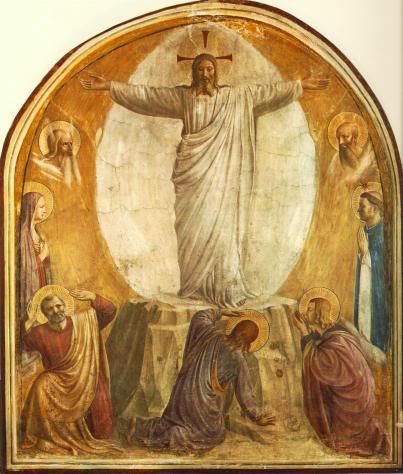
Happy Transfiguration Sunday


When you call to the Lord
God will listen
When you cry out
God will say
"Here I am."

(fresco by Fra Angelico, 1436-45, Monastery of San Marco, Florence)

A Musical Interlude for My Piano Teachers

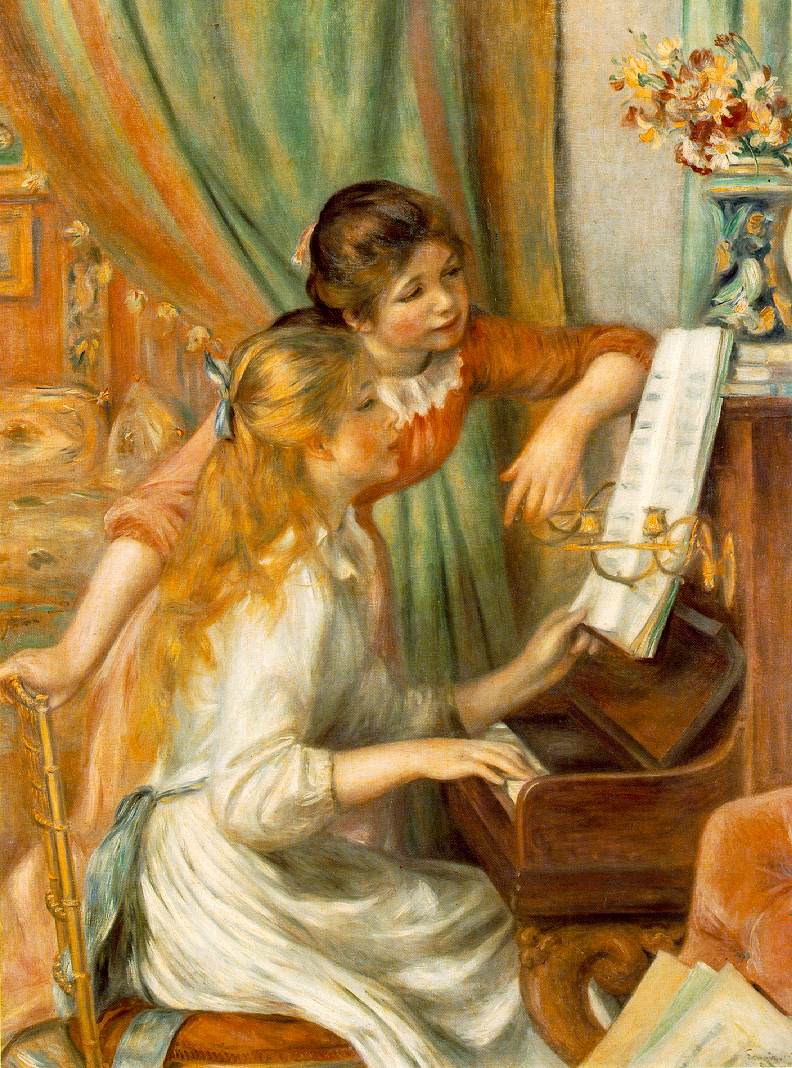
In praise of my own piano teachers and piano teachers everywhere, and to my sister (please stop lurking and comment about your effusive love for Chopin, Rachmaninoff, and Gershwin!) The painting below is Renoir's "Jeunes filles au piano", 1892, and clearly is not my sister and I.


Piano teachers, I realize now, have it really rough in some ways. Over and over again, they have to start at the beginning, teaching kids the very basics of playing the piano: how to hold wrists, curve fingers over the keys and keep your back straight (below are the great Rachmaninoff's hands), how keys in front of them match up to notes on the page and how to “play” those strange symbols, time signatures, scales, chords, the circle of fifths, all those Italian words that indicate speed and dynamics….They have to deal with kids who are only taking lessons because their parents make them, kids who are not prodigies, kids who are never going to grow up to be virtuosos, and yet they must show the patience of Job, trying to instill whatever the kid can learn. They take the time to pick out pieces that will challenge and match likes and abilities, only to have kids not practice – I was one of these kids, although now I have no idea what made me so busy in the afternoons that I didn’t feel I had time to practice. And they have to deal with kids stumbling through and mutilating some of the most beautiful music ever written.

It was my sister, inspired after hearing Natalie Cole’s Our Love, who wanted to learn to tickle and caress the ebonies and ivories herself. After showing sufficient dedication to asking my parents for piano lessons, she got them, and my family got a piano. Thus my fate was sealed: I too was going to have piano lessons one day. I may have wanted them initially, but by the time I started, around the age of 7, I wasn’t as enthused. But my mom never let me quit, partially because we had a piano and someone had to play it, and she was convinced that it would make us better at math. Ha! (My mom gets the last laugh – both my sister and I excel at math and have engineering degrees.)

I took piano lessons for 11 years, reaching the level of beginner’s advanced or so – I had enough knowledge of technique to play any piece of music, but still had lots of work to do on certain skills. But besides exposing me to beautiful music, my piano teachers accomplished something greater. They exposed me to the beauty of the Western classical tradition. They ended any intimidation I felt about classical art, any insecurity that such wasn’t “my heritage.” Indeed, it is probably largely through their indirect efforts that I’m able to speak fairly confidently about all sorts of art and my opinions of it. When you’re looking at music for the first time and picking your way through a Beethoven sonata, Mozart sonatina, or a Bach fugue, you see the bones of a piece and how a composer chose to add the flesh and blood, the dynamics, and as you can see the patterns for each composer, the process of art becomes a little less intimidating. No less remarkable a gift of the composer, you become tied to them in some ways – “Come on Chopin, let’s hold hands and you help me get through this Etude.” See, you can communicate with dead white males. Learning to play the piano was one of the most important experiences of my life.

Thank you, Mrs. Cherry and Mrs. Seagrave, for your dedication.

Now some highlights and lowlights:

I was never comfortable playing very fast – I wish all the pieces I played had been allegro or slower - andante was perfect, but nothing as slow as Satie’s ridiculous numbered Gymnopedie. I spent a year playing the Czerny (Czerny taught Liszt!) etudes, those awful torture devices that make a student work on articulation and fingering to increase speed and require proper placement and use of fingers, wrist, shoulder, and back. But I was never comfortable when the really fast parts came, and this included the ornamentation that composers decide to stick in here and there.

Thus, I hate you Chopin’s Minute Waltz! (Think about playing the above in an interval of about a second.) It was a year of exquisite torture to learn to play you with modest success, and my dear piano teacher would clock the time it took me to play you. To this day, I can’t hear you on the radio without my right hand starting to tremor from all the “rotate your forearm and loosen your wrist to play the trills, don’t try to do it from your fingers!”

I hate every last one of your silly sonatas, Scarlatti!

I love you Mozart, but I could never love playing your works for piano. I spent four months learning your Turkish March, and almost a year learning your twelves variations of "Ah, vous dirai-je, Maman," ("Twinkle, Twinkle) and though I love these pieces when I hear them, you and I are of such different temperaments that I could never really get into interpreting them. Mea culpa.

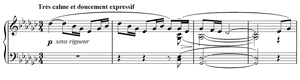
I love you with a love that’s pure and true, Debussy’s Le fille aux cheveux de lin. I loved mastering your chromatics and playing all the black keys. I also loved your dynamics: playing you was like taking a beautiful stroll in the afternoon of a dream world.

I love you, Bach’s Prelude No. 1 (from the Well-Tempered Clavier). Used in Gounod’s Ave Maria, you are like a lullaby and you were my own favorite to end my practicing sessions. And for your Preludes, Mr. J.S. Bach, I forgive you all your Inventions, played with speed and deliberation in all sorts of keys. I'll even forgive your son.

You and I have a love-hate relationship, Mr. Chopin. I never enjoyed playing any of your Preludes or Polonaises, but I do love your Nocturnes (even though my sister way overplayed Op 37 No 1 and Op 55 No 2). Slightly melancholy, even at their greatest difficulty I felt the caress of a great pianist. I especially loved Nocturne in E minor, Op 72 No 1, with its 12/8 time in the left hand and 4/4 in the right, and none of your typical flourishes. Just beats within beats, like lovers who are parting. I always looked forward to meeting you again.

I’m sorry we didn’t get more time together, Mr. Liszt. I do love your Hungarian Rhapsodies, though I was intimidated beyond belief when learning how to play one. You’re bombastic and proud and showy, and I wish we’d had enough time together for you to bring those qualities out of me. Maybe we’ll date again in the future.

I must also give a shout out to Gershwin, Bartok, Schubert, Beethoven, Brahms, and other composers whose work I may have slaughtered, though I loved them. I see you trying to sneak in, Mr. Scarlatti. Go sit in the corner!