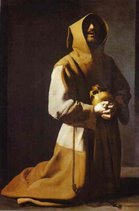
Correggio, c 1531
 Titian, c 1545
 Titian, c 1554
The second problem is that definition: what is science? Our current definition of science is quite narrow compared to all that ‘science’ was thought to encompass from the ancient world through the Renaissance. Our current definition of science involves examining mechanisms in a closed system. By way of crude analogy (that A.V. came up with), if a man brings a modern scientist a car and tells him that something is wrong with the brakes, the modern scientist will test out the brakes, examine the car, examine the brake pads, check the brake fluid, etc. If this man is coming in every week telling the modern scientist that something is wrong with the brakes, the scientist will continue doing the same tests to try to fix the brakes. The modern scientist will not begin to wonder if perhaps the man is a reckless driver with anger management issues who repeatedly hits the accelerator and then slams on his brakes during the drive home. The modern scientist makes the assumption that the answers are “in here” – under the hood of the car – and not “out there”–something is wrong with the driver. (Actually, most scientists would eventually begin to wonder if user error was the problem, which is where the analogy falls apart, but I think you can get the picture.) There is no room to teach ID or creationism in a science classroom – they are not science, as it is currently defined. Now if we were to expand the definition of science (and the tools science uses), it might be possible to teach these things as competing “theories.” (Tycho Brahe and Johannes Kepler, after all, were both astronomers and Neoplatonists, without conflict, where the one informed the other.) But that would involve a larger debate about science, education, and our general philosophical approaches.
When the proponents of ID demand that it be taught in the science classroom, they concede to modern science all the points that matter: modern science, instead of being one way of knowing about some components of our universe, is the best way of knowing; truth can only be uncovered through empiricism, naturalism is the only correct philosophical approach. Most discussions by ID proponents don’t revolve around the problems of naturalism as a philosophical approach, but are instead attempts to say that ID should be included by association with naturalism, the rules of modern science. And that’s affirming that the philosophy behind modern science has superiority above all others for understanding truth.

This past Saturday, A.V. and I visited the
The museum, which boasts "the largest collection of Egyptian-inspired artifacts in the
I must also praise the gift shop – if you have ever yearned for a 5 inch statue of Anubis, or for one of those foot long reproductions of an Egyptian raft on the

The real highlight was the 35-minute planetarium show - “The Mithraic Mysteries.” Anyone who has watched a documentary special on the nativity of Jesus knows that (ahem) December 25th was chosen as the birthday of the Messiah to coincide (ahem) with the celebration for Sol Invictus, a possible title for Mithras, not to be confused with the Persian god Mithra, who also, according to all those documentaries, bears an eerie resemblance to Jesus in his origin, life, and death. Mithraism (surrounding Mithras, who according to most recent scholarship was not directly related to Mithra) was a mystery religion especially popular among Roman soldiers; all that really remains is their iconography. The most famous example, the tauroctony, was the subject of the planetarium show. Derived from David Ulansey’s book, the show explains that the tauroctony may have had astronomical meanings – Mithras is actually Perseus, complete with Phrygian cap, gazing away from the bull (Taurus) that he kills beneath him. The other symbols – the dog (Canis Minor), scorpion (Scorpio), bird (Corvus), and snake (Hydra) likewise have their constellation counterparts. The two boys often featured on the sides, one with torch held up, the other with torch held down, correspond to the crossing of the sun through the celestial equator. Why would they depict the night sky in such a way? According to Ulansey, Mithraism developed in the first century B.C. in Asia Minor, shortly after the discovery by Greek astronomer Hipparchus of precession – the change in direction in the axis of the earth that most obviously causes our “North Star” to change over thousands of years, but also causes the celestial equator to cross the zodiac at a different location during the spring and fall equinoxes every couple thousand years. At the time of his discovery, however, it was believed that the earth was fixed, with various arcs and celestial spheres moving around it. Hipparchus had therefore discovered a new ‘force’ that moved the spheres around the earth, a force that may have been associated with Plato’s 'hypercosmic sun' existing outside the known universe. The tauroctony depicts the constellations that the celestial equator passed through during the Age of Taurus, about 5000 years ago. (The representations in the constellations most likely had additional meanings that played a part in the beliefs about the world and the rituals that believers performed.)
It’s a bit amusing to speculate that the participants in the Mithraic cult were actually worshipping precession, the silly pagans. But it also shows the spread and importance of the Platonic belief that the soul would descend at birth, and ascend at death, through the heavenly spheres to the One that exists outside of creation, and provides clues as to why Christianity may have been seen as especially attractive to converts.
We didn't get into any conversations with Rosicrucians, unfortunately. We did pick up their nice brochure, and peruse the books in the gift shop - nothing quite like books by 20th century mystics about the secret mysteries of Christ! - but the Rosicrucians got to keep their own mysteries.

From an article in the National Catholic Reporter; I attended St. Mary's during my four years at Texas A&M:
St. Mary's Catholic Center at Texas A&M University is among the biggest and most dynamic campus ministry programs in the country. It's a vocations powerhouse, having produced 112 priests and religious so far, with 39 more Aggie alums currently in formation. Each year the center averages 8-10 vocations to the priesthood and religious life; last year's total was 16. By itself, St. Mary's therefore generates more vocations than many dioceses. The center's six weekend Masses regularly draw around 4,000 students. (Roughly 25 percent of A&M's student population of 45,000 is Catholic.) Konderla says that the unique ethos of A&M -- drawing students from rural, intensely religious parts of Texas -- is part of this picture. Paul Holub, a 22-year-old health education major who's considering a vocation to the priesthood, told me that it's not uncommon for Catholic and Evangelical undergrads to get "sidetracked" during study sessions talking about their faith -- pivoting especially, he said, on what it means to be "saved."

Only recently have prima ballerinas become artistic directors of ballet companies. While there have been women in charge of ballet companies - Lucia Chase of ABT and Ninette de Valois of The Royal Ballet (British), who both had undistinguished careers as dancers – to have one of the greats, and much less one still dancing, directing a state-funded ballet company is quite novel. In interviews, Nina Ananiashvili* has stated how important it was to her, after the civil war in her home state of
Nevertheless, Ms. Ananiashvili has taken her company on their first American tour (
George Balanchine’s Chaconne (music by Gluck)
Balanchine’s Duo Concertant (music by Stravinsky)
Alexei Ratmansky’s Bizet Variations (music by Bizet)
Yuri Possokov’s Sagalobeli (traditional Georgian music)
Overall company impressions, brilliantly shown in the opening Chaconne – the women are thin, but not the willowy, long-limbed variety that’s currently (over) bred at the Kirov and Paris Opera Ballet. They have the famous Russian backs – the gentle arch in the back, creating S-shapes from head through center through hips and legs, and the heads are thrust a bit more forward than I would like, but there is also a great deal of enjoyment in seeing a corps de ballet that seems to share the same training. The coordination of head, body, arms, and legs are similar throughout the company, lending a welcome uniformity (especially since I’ve recently seen corps work from Miami City Ballet, ABT, and the Joffrey Ballet, in whom, to me, the diversity in the training of the dancers was at times distractingly strong). The men tend to be big, with wide torsos and wide thighs. At first I enjoyed this aspect – most of the popular male dancers today tend to be tall and long-legged like their female counterparts, sometimes looking a bit overstretched, or they are short powerhouses. It was wonderful to see men of the type that comfortably danced danseur noble roles in the Soviet era. But the men here don’t use their physical size to maximum effect. They don’t move big, those wide thighs don’t translate into power, and they suffer from the slowness that larger bodies can often have (they suffer even more from unpointed feet). In many ways, Balanchine’s classicism in Chaconne was an ideal way to challenge those bodies, and make them work their technique, and I admire Ms. Ananiashvili’s decision to challenge her company in this way. Her own explanation for the inclusion of two Balanchine pieces was that Balanchine, though not native-born (he had never even been there prior to NYCB’s tour to the
Chaconne (originally choreographed by Balanchine for the Paris Opera in 1963 to music of Gluck’s opera “Orphee et Euridice” and re-choreographed in 1976 for his own New York City Ballet) begins with nine women garbed in flowing dresses, with their hair flowing down their backs, softly bourreeing around the stage, tilting their heads and arms. The location is Elysium, and the narrative is blessed spirits walking amongst the clouds. (Indeed, much of the dancing, even when we re-join the cast back on earth, focuses on ways of walking.) As the nine women slowly glide off-stage, a man and woman appear, circle each other, and then begin to test out the cloud-covered ground. To the extended flute solo, he helps her swoop, hover, and swim in the clouds. Anna Muradeli and Vasil Akhmeteli were the dancers here. Ms. Muradeli is a beautiful woman, and adagio is her range. Whereas Suzanne Farrell, the originator of the role for NYCB, conveyed a certain sadness and longing, Ms. Muradeli conveyed a sublime ecstasy in her walk in the clouds. Akhmeteli holds her in arabesque in his arms, and while she swims in the air, he walks her off the stage. A lovely beginning. (Ms. Farrell and Peter Martins can be seen here dancing the part.)
Suddenly we are out of the clouds and planted on terra firma at court. After a brief prelude featuring enjoyable dancing from the corps de ballet, a trio enter (Rusudan Kvistsiani, Ekaterine Chubinidze, Otar Khelashvili) to perform a little court dance – the women display their delicate footwork while the man dances behind, miming the playing of a lute. Here, the man lagged behind the women in his footwork and jumps, marring the image. Next comes a short dance for 5 women, and then a fast, athletic pas de deux (danced here by Tsisia Cholokashvili and David Khozashvili). Ms. Cholokashvili was an exuberant bounding ball of energy while still maintaining elegance of line. Khozashvili had a near major mishap in partnering, but overall did admirably well – she was so sprite it hardly looked like she could be caught. Finally, the king and queen (or consort and queen, as Balanchine probably would have described it) enter their earthly realm. Whereas in heaven her feet gently tested the clouds and then glided above them, here they stab at the ground to sharp accents in the music. He alternates between soaring (grand jetes) and small beats of the legs (entrechats, brises), indicating his own mastery of ground and air. And here is where our two principals started to falter. I didn’t expect Ms. Muradeli to have the same massive power and sweep of the legs and voluminous plush in movement of the hips and thighs that Ms. Farrell did (those were defining features of Ms. Farrell in action), but she should have been able to find her own wit. The pas de deux and variations are about the contrast between big and small, sweep and filigree. The ballerina role requires power and delicacy simultaneously (being able to hurl a leg like a thunderbolt - as Croce wrote of Farrell’s abilities - and then gently, with no loss of control, present it to the ground like a Lipizzaner). Ms. Muradeli couldn’t stay with the music (already at a ridiculously slow tempo to accommodate Akhmeteli), nor did she seem to be listening to the music enough to hear that she needs to move her feet strongly down on the beat in those soutenu turns and emphazise the swizzle effect – it’s in the music. Indeed, if she had poured less concentration into getting through the steps and more to following the musical cues/clues, she would have had an easier time of it. An easy time was certainly not in the cards for her partner, however. Even with a tempo slower than molasses he was straining to complete the steps, and was consistently off beat. He was working hard, very hard, and after awhile, one had to admire the fact that he was making a concerted effort NOT to sacrifice the steps, and not to take the easy way out by just smudging everything together (there was little else in his variations to admire other than his mostly quiet landings). Catch Ms. Farrell and Martins dancing this part here, and imagine the tempo for the variations decreased by about HALF, to LESS than the tempo for the pas de deux that begins the section. The sense of the dancers creating a whirlwind that they have complete control over was lost, and the final chaconne suffered accordingly – the ballerina had never established herself in her realm. Ms. Muradeli seemed to think she could get by with her prettiness and flirty looks and smiles at the audience (quite a contrast from Ms. Farrell’s impassivity), but there was no cohesion among the parts here. Also breaking my own mood was the look of the women’s dresses – on top, they had an odd circles and spiral effect that was mostly in pale blue, with a large white cutout below the right breast that extended around the side. In summary, they looked like leotards for rhythmic gymnastics dating from the Soviet Bloc era – distractingly unattractive. I did like the gold trim at the bottom of the skirts. Chaconne is a good opener, but the dancers looked like they needed a lot more work mastering this style of classicism, and the ballet received tepid applause (the reluctant “we can tell you worked really hard” kind).
Duo Concertant followed the intermission. This work, choreographed by Balanchine to Stravinsky’s music for violin and piano, features two dancers along with a violinist and pianist, all on stage. The dancers at times listen attentively to the music, move away and begin dancing, and then come back and listen again. Nino Gogua and Lasha Khozashvili, arms resting on the piano, immediately caught the eye. Ms. Gogua is small and thin and has the huge eyes and small mouth associated with perpetual adolescence (especially her pale skin contrasted with her dark hair and eyes), but she is not frail looking. Khozashvili has a mop of very curly dark hair that makes him look more boyish than his dancing turns out to be, and lean muscles and lines – he does not fit the big man Georgian mold the other male dancers do. From the beginning, they knew how to relate to each other, the music, and the choreography. She turned out to be a technical whiz – fast and light, flexible and yet soft. He likewise showed so much attentiveness to the phrasing and the small details that I was astounded. They also had a real rapport, making the final section of this ballet reverberate even more. In the final section, the dancers turn from relating to the musicians to relating to each other. Just as they were inspired by the music, man is inspired by woman, Balanchine seems to be saying. Having seen this ballet live twice with NYCB principals Yvonne Borree and Nikolaj Hubbe, this performance blew those two away. It deserved the loud applause it got.
Bizet Variations by Alexei Ratmansky followed. Ratmansky is the artistic director of the Bolshoi Theatre but plans to leave that position later this year to pursue more choreographing opportunities. He has already received much praise for ballets he has choreographed, and this evening was the American premiere of this work. He follows the lush romanticism of Bizet’s work too closely. The ballet is for three men and three women, and my first distraction was the costumes – shades of shimmery purple with turquoise accents. The women wore royal purple, lavender, and violent dresses with turquoise underskirts; the men wore purple shirts. There were a lot of sequins in the headdresses and on the bodices. I alternated between finding them acceptable considering the overly dramatic music, and thinking they looked like bad outfits for an ice dancing competition. The story is something like: there are two guys and two girls. Another guys comes along, both the girls think he’s a real hunk and go after him, much to the displeasure of the two guys. All of a sudden, another girl, the prettiest one at the ball, comes in, and the three fellows want her, but of course the hunky guy gets her, while the other two go back to their previous rejects. But then the five, in their excitement, run off and leave the prettiest girl alone. She’s sad, dejected, dramatic. Then they come back, the hunky guy takes the prettiest girl in his arms again, and all is well. Gimmicky, largely forgettable, clichéd, lacking in texture, were all words I wrote in the program. At one point all three men even fall to the ground and slide on the stage towards the women doing tendu back. Yes, that clichéd – I think Susan Stroman used it in her utterly awful “ballet” for the teen
Sagalobeli (pictured above), also an American premiere of a work by San Francisco Ballet’s resident choreographer, Yuri Possokhov, was the closer. I wanted to stay for this piece if only to listen to the Georgian traditional music (a taped performance by the Sagalobeli Ensemble). In the program notes, Possokhov comments that he did not want to make a Georgian folk dance, yet what he accomplished seems to me to be a work that uses the ballet idiom but has a folk dance aesthetic. The women, wearing long dresses, dance in pointe shoes, but they move in bourrees – a feature of Georgian dancing for women – or in heel motions. There’s a lot of sinuous arm movement and hip swaying that goes on too. The men, in their outfits that look like a less sado-masochistic version of the Bolshoi’s Spartacus costumes, do a lot of the flexed foot, wide stance, fast jumps associated with folk dances from the Caucasus. While they never actually start doing the lezghinka, the aesthetic is there. The music was a mish-mash, lovely but lacking in cohesion. The dance was the same way – I don’t think the audience knew when the ballet ended. And yet, even with the lack of cohesiveness, I enjoyed the work and felt with a bit of re-tooling, it could be quite a good work and perhaps a signature piece for the company. The dancers clearly have a natural feel for this music – they were rhythmic and expressive in a way that was lacking in the Balanchine piece. Of course, this work was also not as technically challenging, but they really impressed me with their level of assurance and the authority they conveyed - one could see a proud stance even in the position of their shoulders. Both Ms. Gogua, this time for her beautiful floating adagio, and Khozashvili again really impressed me – the eye is drawn to these two. Khozashvili has a marvelous upper body for a male dancer – capable of being sinuous and expressive while never becoming effeminate. He’s also an incredibly clean dancer who can jump high while still maintaining his lines. This was also a piece that showed off the men, and they really took to this take-off of male folk dancing. It reminded me that folk dancing is regarded as a very masculine activity in
Final note: the lighting throughout all the ballets was absolutely awful. At times it was too dim, then the spotlight would be on the wrong person or on the wrong area of the stage. I felt lucky to be sitting fairly close so that it wasn't TOO distracting, but gosh, that was an extremely poor lighting job.
*I haven't written more about Ms. Ananiashvili because a lot of biographical material about her and reviews of her dancing are easily found online. She is also featured in a number of videos. A quote from a recent interview with her:
I think we do this for people, because life has become so computerized, we have forgotten how to talk to one other. We do this for the future, for our kids. Ballet brings back human love and human life — we need to have contact with each other during these crazy times. If you see good theater, good art, you don’t want go out and kill people, you know? If you get inspired, you want to tell other people, to share it. Once, a postman told me he used to love opera the most, but then he saw me dancing on television, and he began to really like ballet. That is why I do this job—to make people happy. There are times after a performance when fans will come to me and say that they feel lucky in their lifetime to have seen me dance. This is wonderful. It reminds me that as a dancer, you really don’t live for nothing. You live for something.