Saturday, March 17, 2007
Praise God!

The Liturgy and The Whining
These are serious concerns, and I am not making light of them. (I've posted about it previously here, so please don't think I'm ignoring the experiential aspect of the liturgy, but at the same time those who honestly believe the Novus Ordo is automatically outright heretical are, IMO, off their rocker.) Rather I'm questioning the effectiveness and purpose of pronouncing it in the echo chamber of the internet, a medium which can often make things seem far worse than they are (it's far more sensational and noteworthy to complain than it is to praise). I'm baffled as to how individuals who one would think are well-read enough to know better, sometimes behave as if this is the first time in history bishops have done extremely strange, detrimental, and even heretical things! And I'm certainly questioning the whiny tone in which the criticisms are sometimes delivered, as if God should have dropped all manner of wonderful things in your lap, including the liturgy of one's preference. Please, let's not mistake aesthetic fetishism for spirituality.
And as for spirituality (since I've already played the gender card, it's only fair that I play the race card now), my grandparents lived in a place and time where they had to pay to attend Mass and then were usually not allowed to sit. Other black Catholics in this time period were not allowed to even stay to the end of Mass, so as to avoid any contact with the white congregation. Many black Catholics in southern Louisiana actually had no place to attend Mass, as they were banned from the white churches. Forget whether or not they were spiritually nourished in a Latin Mass, for they were not allowed to enter the Church. Thus, they lost their faith. That is grievous error, that is a Church hierarchy completely and lackadaisically disregarding the lowliest members of the community. Thanks be to God that I live in a time where I am not banned because of my race from attending a Catholic Mass! Thanks be to God that I do not live in a time and place where I would have to worship Him in a cave and risk being hung upside down if discovered! Thanks be to God that He has given me the opportunity to be literate, and read volumes of books, if I so choose, about the liturgy! Praise God for giving me access to the internet, where I can come on here and praise Him or whine about His Church! Thanks be to God for sparing me the suffering of impaired fingers due to motor disorders as I sit here and type this, and for preserving my fingers from mutilation for believing in Him that I would have suffered in previous centuries!
I have walked out of Masses, I have been surprised that my head hasn't spun 360 degrees during some, I have prayed the Chaplet of Divine Mercy rather than listen to a priest's homily, I have written letters to CCD directors, priests, and a bishop or two about the state of catechises and practice. Then again, I am a Novus Ordo baby, and can count on one hand the number of times I have attended the traditional Latin Mass. Perhaps what I post about on my blog is reflective of all the inherent problems in the Novus Ordo and the graces I haven't gained, or maybe that's just my personality and sinfulness. Either way, while I certainly acknowledge the pain of bad Masses, I think it's oh so much to get worked up about on the internet. Otherwise, I'd begin to suspect that Daniel got it wrong in his interpretation: Have It Your Way certainly must have been written by the finger of God on the wall of Belshazzar's palace, or maybe it was on the original tablets that Moses threw down in anger when he saw the Israelites with the golden calf.
The above is irreverent, but what really bothers me about the complaints is the hand-wringing. When reading them, I often think of Hamlet's line to his mother:
Leave wringing of your hands: peace; sit you down,For that is what we should be inviting Christ to do. Instead of getting worked up about the current liturgical problems (to the point, for Heaven's sake, of going to a different rite or Church), why not pray to Christ for change, and for that change to begin with you? It's always baffling to me that the very same people who denounce the modern Catholic Church as ultramontanist seem to believe in a caricatured ultramontanist model of the Church most strongly - that other members of the Church have no input through the grace of the Holy Spirit in the body of the Church. That it would mean nothing to sit/stand/kneel through an awful Mass, offer up your suffering to God, and pray to His Blessed Mother and the saints for order in this chaos. That Romans 12 somehow no longer applies. Why not pray Galatians 2:20, for Christ to live in you, for His graces to pour into you to transform the Church Militant, which is in constant need of renewal? Why not stand with the saints who have loved this Church and instead of complaining to internet strangers for something to be done, pray to God "Why not me?"
And let me wring your heart... Hamlet Act III, Scene IV
Lucky for me on this ranting day is the beautiful Prayer of St. Patrick that implores Christ to enter our lives and surround us (the entire prayer can be found here):
Christ with me, Christ before me,Happy St. Patrick's Day! (Rant over. And BTW, I'm right and feel no need to argue, so don't bother debating me.)
Christ behind me,
Christ in me, Christ beneath me,
Christ above me,
Christ on my right,
Christ on my left,
Christ when I lie down,
Christ when I sit down,
Christ when I arise,
Christ in the heart of
every man who thinks of me,
Christ in the mouth of
every one who speaks of me,
Christ in the eye of
every one who sees me,
Christ in every ear
that hears me. Amen.
St. Patrick, pray for us.
Cystic Fibrosis and Chloride Conductance
 Cystic fibrosis is the result of reduced Cl- conductance in epithelial tissue. An autosomal recessive disease that is a result of a mutation on chromosome 7, affecting the cystic fibrosis transmembrance conductance regulator (CFTR), patients with cystic fibrosis die young, usually of lung failure. (There are also problems with sweat, pancreatic function, and infertility.) There is currently no cure; gene therapy is probably the best hope for the future. (I will post about gene therapy in the future.)
There are several classes of mutations in the CF gene that can be responsible for the malfunction in chloride conductance. These mutations disrupt CFTR function in the following ways: preventing expression of the transcript, reducing cell-surface expression of CFTR, impairing channel regulation, or by altering the channel properties. However in 70% of cases, the mutation is a three-nucleotide deletion which eliminates the amino acid phenylalanine from the protein CFTR, and because of the location of the absence, CFTR does not fold properly and cannot leave the endoplasmic reticulum/Golgi system.
As a consequence of these changes, chloride ions (negatively charged) that usually move passively through the CFTR and maintain equilibrium between the intracellular and extracellular space, now become trapped inside the cell. This in turn disrupts the electrical gradient, so that sodium ions (with their positive charges) also do not have their usual concentrations inside and outside the cell (sodium now stays inside the cell). Since NaCl becomes trapped inside the cell, water also moves from the extracellular space into the cell by osmosis, resulting in the accumulation of a higher than normal concentration of salt outside of the cell - the basis for the sweat test for cystic fibrosis (patients have higher than normal concentrations of salt in their sweat).
Due to this accumulation and the lack of normal water transport, the fluid layer in the lungs becomes more viscous and contains a higher concentration of mucous than in normal patients. The mucous plugs impair breathing and trap bacteria, making infection more likely. Additionally, the high NaCl concentration of the surface fluid in the lungs inactivates the antibacterial agents secreted by the lung epithelial cells. The bacteria therefore multiply, and most CF patients have established chronic pulmonary infection within the first few months of life. The resulting inflammatory response contributes to the mucous and leads to chronic lung damage.
So see how much trouble a little thing like negatively charged chloride ions not being able to move out of your cells can cause?? I hated taking a course on ion channels my first-year in grad school (I'm a behavioral neuroscientist, and had had all the electrical engineering I wanted in college), but the darn things are actually very important.
Information taken from Ion Channels and Disease (2002) by Frances M. Ashcroft. Graphic and description can be found here.
Friday, March 16, 2007
For Someone I Love
I wish I could write you poetry, but you wouldn’t want to see me make the attempt. But here are the things I will do for you: I will re-learn Spanish so that I am capable of reading Sor Juana Ines de la Cruz, Gabriela Mistral, and Jorge Luis Borges in their native language. I will even “cutely” read them to you in Spanish. I will re-learn, in Latin, all the prayers my mother taught me. I will never play Mahler for nine hours straight. I will never be able to pronounce your name correctly, but instead of calling you V for Volatility, I will choose something more suitable. I will not watch 300 for the hot men, and avoid making you feel any jealousy. I will climb to the top of a mountain with you, without complaining. I will receive the Eucharist in whatever way you decide is suitable. I will listen to Glass and Reich, if I must, for extended periods of time; and will not make you listen to Webern. I will cook, and not always make you wash the dishes, and I will not force you to make pumpkin bread or any other baked goods for me. (I can also mow lawns!) I will trust you, and be unafraid. And I will love you.
300, briefly
Forewarning: Pseudo-Iamblichus honors me and other bloggers for our meditations on Roman Catholic life, art, and practice, and this is what I’m posting today. Alas, I can’t pretend to talk about Catholicism all day - count me in with the great sinners that make up the Catholic Church and need it so desperately. And do not take this post to mean that Christ in my life hasn't taught me better, I'm just still human.
This has to be the most homoerotic (for men) movie released in wide distribution in a LONG time. My gosh, men in nothing but thongs and capes, moving in slow motion. Men with really defined musculature disposing of bodies wearing nothing but boots and leather straps. Men’s six-packs, men sweaty, men naked, men's backs, men’s thighs…this is not a movie I should have been watching during Lent (or perhaps, any other season if I want to be a good Christian). And I got to see it on IMAX (this movie would have been completely unacceptable in any other format). I had to take my coat off, and even though it was cold in the theatre, there were times when I could have used one of those fans that spray water to cool down. If I ever bought this movie, it’s the type I’d hide under my bed. Because it’s that bad, and oh, that good. If you’re a woman or a gay man, and someone who temporarily sets aside the sinfulness of lusting and sexual objectification of others, this is a must-see movie. And on the biggest screen you can find.
Thursday, March 15, 2007
Diamonds and Details
Mr. Tully is a well-respected and credentialed Pacific War historian. You can buy Shattered Sword, and be on the lookout for his upcoming book about the Battle of Leyte Gulf (from Indiana University Press). But he also really loves Late Roman Empire and Byzantine history (be still, Niketas Choniates). He's the only person I've ever known whose major question in heaven would be to know the location of the Chrysotriklinos in Constantinople. He has a real gift for narrowing down political discussions to the underlying issues, and an incredible eye for photographic detail, as can be inferred from the above post.
Mr. Tully is indeed the reason this blog of mine even exists; he set it up for me himself as I refused for over a year to have my own blog and to lift a finger setting one up. So you can go over to his and at least throw tomatoes for any time you have wasted reading one of my long-winded blog entries. He also posts about politics more than I do, so be sure to harass him (or not) for his political views. One can also read my comments (pseudonym Psych) to some of his posts when in full "go sit in the corner" mode, if one wants to see my debating rottweiler persona (here and here, downright rabid and talking to myself - one can see why I don't post about politics on my own blog).
Deception
 Betrayal (1978), written by Harold Pinter, directed by Rick Snyder for Steppenwolf Theatre. Jerry (Ian Barford), Robert (Tracy Letts), Emma (Amy Morton) in March 13, 2007 performance
 Briefly, The Unbearable Lightness of Being (1984), written by
Betrayal is a play about a love triangle. The plot: Emma has a seven-year affair with Jerry, the best friend of her husband Robert. Time moves backward, so we see the results of the affair before seeing its evolution and beginnings. It takes us out of the emotions as the characters are experiencing them, as we know that all their dreaminess at the beginning is going to end in disillusionment. The language is acerbic, the kind of language that only works in a theatre (one of the major problems with the movie version of Closer was that it was impossible to imagine that sort of speech away from a stage.) The performances were good, though I wish that they had dropped the English accents (the play is set in
[Note: the play is also a bit dated, and not just in clothing and hairstyles. Set from 1968-1977, it’s now impossible to believe that a couple would have an affair for seven years including setting up a “second home” for their liaisons, but claim to not want to split up their respective homes because it would be so devastating for their children. Nowadays they would have just gotten divorced from their spouses around two years in, gotten married, and been some semblance of a big happy family. Honesty and personal fulfillment are more important than obligation and responsibility, or so it goes now.]
The play focuses on lying and hypocrisy: when Emma tells Jerry that she and Robert are separating (two years after their own affair has ended) and she has told Robert about the affair, they are both horrified that Robert himself has been cheating on Emma for years and Jerry is angry that Robert has not told him that he’s known about Jerry’s affair with Emma. (As stated earlier, because time is backwards, this occurs at the beginning of the play so all the interactions between these characters going back over the years are seen through the filter of what is to come.) The female perspective – why Emma has an affair with Jerry for years – is missing. However, it is entirely credible, given Jerry and Robert’s interaction, that what Robert is saying is true: “I never told you I knew [about Jerry and Emma's affair], because you’re my best friend and I probably prefer you to her anyway.” Ouch.
We’re also unsure why Jerry and Emma ever started their affair. The usual “thrill” of an affair is the risk of getting caught. But Emma is caught five years in, and continues on for another two years anyway. Is the betrayal itself exciting, in a passive-aggressive manner?
Betrayal is really about deception. All three characters do what deceivers do: to deceive is to construct a reality of one’s own making. In The Unbearable Lightness of Being, Tomas and Sabina do likewise. They betray and deceive, in order to be lighter than the air, because such decisions ultimately do not matter (contrasted with the idea of eternal return). But it is also unbearable that these choices are insignificant, that lives could be insignificant. The worlds they make, which they think make them float, in fact burden others, force others into the same silence.
The world of deception is ultimately a world of self-imposed silence. It mimics the world of the flood, when God silenced humanity for its transgressions, except it is self-inflicted. It is to be in prison, where the only language one knows, and the only world one can construct, is limited by one’s own darkened imagination. It is a curse to be unable to communicate with others: “And now you will be silent and not able to speak until the day this happens, because you did not believe my words, which will come true at their proper time" (Luke 1:20). To lack language that speaks to others is to relive the curse of Genesis 3:14-19: “He laid His hands upon him and diminished him” (from B. Sanhedrin 38b), and to be unable to stand and tremble before God. (I need to blog about standing before God soon; wait for it.) Indeed, God is to be praised for “He has preserved our lives, and kept our feet from slipping (Psalm 66:9). And so the Psalmist prays, “Set me free from my prison, that I may praise Your name” (Psalm 142:7).
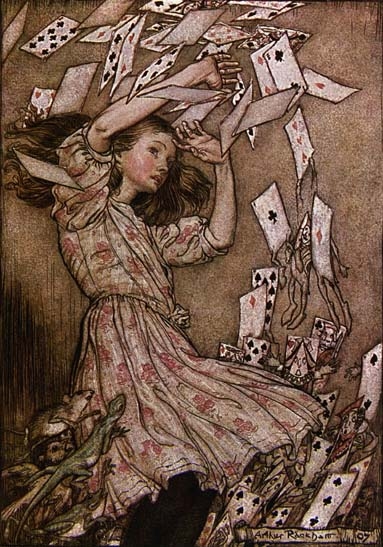
The illustration is Arthur Rackham's Alice and the Pack of Cards (1907) and I like it - I'm not suggesting that Alice in Wonderland is a story of childhood self-deception. Just like I'm classifying this performance as a movie though it was a play.