Wednesday, February 28, 2007

Books on Balanchine

Only God creates; I assemble. - George Balanchine

I was recently asked to suggest a good book on Balanchine. The first book I'd recommend is Garis' Following Balanchine (for reasons I explain below). Unfortunately, there are no exceptional biographies of him that combine thoroughness with insights; so far, all the biographies written about him have been no more than serviceable. Of those, Robert Gottlieb's George Balanchine: The Ballet Master (2004), part of Harper's Eminent Lives series, gives perhaps the best brief overview. Gottlieb knew Balanchine for several years and was on the board of directors for NYCB, and he's respectful, sensitive, and engaging about his subject. A more thorough book, though not more insightful, is Bernard Taper's Balanchine: A Biography (reprinted 1996), some parts of which were written and published while Balanchine was still alive and able to confer with Taper. (One can read a "brief" 4 part biography of Balanchine here.)

IMO, the best book on Balanchine, the man, is I Remember Balanchine: Recollections of the Ballet Master by Those Who Knew Him (1991), edited by Francis Mason, a collection of 85 interviews from people who knew him. If one wants to know how Balanchine impacted the lives of those he came into contact with and how he was frequently several different personas to many different people, this is the must-read.

Balanchine's own opinion, told to Taper after reading a copy of Taper's biography: "You've written too much about me, and not enough about my dancers."

And so, there are the autobiographies of dancers associated with him: wives Tamara Geva, Alexandra Danilova, Vera Zorina, and Maria Tallchief have all written autobiographies. (Tanaquil Le Clercq, Balanchine's fourth or fifth wife, depending on whether his common law marriage to Danilova is counted, never wrote an autobiography and largely refused to speak about her life with Balanchine. A prominent ballerina at NYCB in its infancy, they married in 1952, but in 1956 she contracted polio and remained paralyzed from the waist down for the rest of her life. After setting aside his work and diligently caring for her for almost two years, he returned to NYCB and in fast succesion choreographed Agon, Stars and Stripes, Gounod Symphony, and Square Dance. They separated after he fell in love with Suzanne Farrell - and made it known to the whole world - and they divorced in 1969.) Dancers Barbara Milberg Fisher, Jacques d'Amboise, Edward Villela, Allegra Kent, Suzanne Farrell, Peter Martins, Merrill Ashley, Toni Bentley, and Gelsey Kirkland have also written autobiographies in which he plays a prominent role.

Of these (so you have no doubts that I have indeed read every single book about Balanchine that I'm referring to here and plenty more than I'm not including), Milberg Fisher presents a fascinating account of life as a corps member and soloist in the first decade of NYCB; Kent's is the wittiest and most "out-there." Gelsey Kirkland's is probably the most famous and the harshest - her Dancing on My Grave (1986) practially (and completely unfairly) lays at the foot of Balanchine her eating disorders, obsession with plastic surgery, and drug addiction, and she was undoubtedly still very unstable when this book was written; however, she and Villela provide the few dissenting voices among the many, including his wives, who describe him as a near deity. And Suzanne Farrell's is, of course, my favorite.


If one is interested in the music angle, Charles Joseph wrote Stravinsky and Balanchine: A Journey of Invention (2002), about the artistic collaboration of these two geniuses (warning: a good knowledge of music is recommended for reading this book), and Balanchine's own opinions on Tchaikovsky and other Russian composers, the St. Petersburg of his childhood and the Revolution, Russian writers, Diaghilev and the Ballet Russes, and other topics are contained in Balanchine's Tchaikovsky: Interviews with George Balanchine (1985) by Solomon Volkov. This book is invaluable if one wants to hear Balanchine's "voice" and ideas on the arts near the end of his life. If one wants to hear Balanchine's actual voice, watch Balanchine.

If one is interested in Balanchine's choreographic output and wants to learn the impact of his work and his dancers on the life of a member of the audience (who was also a music critic and professor of English), Following Balanchine (new ed 2006) by Robert Garis is required. I'd probably read this book and Gottlieb's brief biography in tandem, to gain a hold of Balanchine's background and his creative output at NYCB through the eyes of an audience member. This book is also the must-read for anyone who believes that one's life can be profoundly affected through art and wants to understand why Balanchine's work mattered so much to people; as one NYCB audience member of the 1960s and 70s wrote, "Balanchine was our God and the State Theater was where we worshipped." (Balanchine himself would not have wanted to be called God, though he did once say, in response to why he only had the title "Ballet Master" at NYCB, as opposed to artistic director or head choreographer, etc., "God doesn't have to call Himself God.")


Unfortunately, no biographer has been able to crack the enigma of Balanchine, the man and the work. Ballet fans have been waiting over a decade for eminent dance critic Arlene Croce's promised study on Balanchine and his work. Part of the problem is certainly that Balanchine himself was not interested in introspective self-analysis and even to those close to him he was impenetrable. Whether because he was a life-long adherent of the Russian Orthodox Church or he had a massive ego and was utterly secure in his own choreographic genius - though he would be the first to point out that God gave him his gift for choreography and God told him, "This is the only thing you're going to be good at" - or he followed his judgment alone: "I like what I like and I disagree with everyone and I don't care to argue." A slightly more self-deferential quote in response to a question about the hows and whys of his many marriages and affairs and how it tied into his artistic output: "I am a dancer; I lead a dancer's life. It's like a horse. No one asks a horse what he does - he just leads a horse's life. That's what I do."

Tuesday, February 27, 2007

Oh, the people you meet...

The Sarabite has honored me with his own blog entry, On Statues..., based on my Lenten New Orleans post. Please read it.

Then read my comment to his post, reproduced here below (I decided my thesis writing could wait a few more minutes):

Sometimes I feel like singing “gimme that old-time religion,” ‘cause I love me some Roman Catholicism, with all the prayer cards and scapulars and plastic statues sitting out in the yard. Where you hold your breath to hear about saints who have had the stigmata or Mary’s consecrated life in the temple. As I wrote on my own blog, I left deeply rooted Catholic soil when I was in six. I’ve been living in Protestant America since that time. I first entered it when my family moved to Houston and we became parishioners at the local church that was pentagonal and had a flat, mosaic, empty cross above the stage/altar and I was a member of the children’s choir, singing only songs that were composed after 1960. That’s Novus Ordo to me.

I don’t know what my faith would be like had I not been raised in a devoutly Catholic family where we said Rosaries and litanies every day, in a constant cycle of novenas. I learned my faith in the family, for after the age of six, the local Catholic parishes were of little to no help other than as dispensers of sacraments; CCD classes were even detrimental.

My mom would sign us up for all manner of ‘traveling’ religious artwork, so the pilgrim statues of Our Lady of Carmel, Our Lady of Fatima, Our Lady of Lourdes, and a painting of Our Lady of Guadalupe would visit our house for a month at a time, and we’d keep a votive candle burning next to her and pray in front of these depictions of the Blessed Virgin every night. When we were in pain, the first response out of my mom’s mouth was, “offer it up for the poor souls in purgatory.” We blessed ourselves with holy water every time we left the house and Lourdes water was always on hand, as were palms from Passion Sunday to burn above a candle whenever bad weather approached. My mother also kept a picture of Christ’s face, in agony and covered in blood while wearing the Crown of Thorns, on our refrigerator door. The big pictures of Mother Mary and Jesus with their chests opened and fingers pointing towards their Immaculate Heart and Sacred Heart, respectively, were in the bedrooms. Even now, my mom calls me whenever she lights a candle at church for me – which is as soon as the last candle she lit for me has burnt out - to tell me to make sure I say a special prayer to St. Joseph or Mary.

I was once involved in Catholics apologetics – I left it not only because I got tired of the same old arguments, but because of the intellectual oddities of some of the Catholic converts I would encounter. A former Baptist who, when asked why people light candles in front of statues of saints, said “of course we pray to the saints, but the candle lighting is just some superstitious thing some people do.” A former Presbyterian who, after attempting to explain a few of the Marian teachings, said “as a Catholic, you actually pay very little attention to Mary. It’s no big deal – other than the only three times she’s mentioned in the mass, you don’t have to do any of the other Marian devotion stuff.” What kind of Roman Catholicism did these friends of mine convert to? What in the world did they see in the Church? Why in the world do they, newborn in the ancient faith as they are, think they know better than people who have lived it for generations?

I suspect they had a hankering for a connection to the apostles, but with the 2000 years between then and now somehow smoothed over and wiped out. I sometimes think they became HUGE defenders of every Catholic teaching because they want that apostolic succession to be true OH SO BAD, because otherwise, why even bother being Catholic? They seem to find only the certainty of it attractive, not the ‘get your arms in all the way up to your elbows’ ways it’s been lived out (prior to V2, of course). I think it’s a hollow religion they have, one where they love being part of the communion of saints but are completely embarrassed that anyone would have such an effusive love for Mary and the saints that they’d seek to have depictions of them around, even if it’s bad artwork. Somehow the assent (bad Newman!) to Catholicism is, so they think, more important than the experience. I have no idea what kind of Church people like my Catholic convert friends are trying to re-build. We believe that a crucified Jewish carpenter rose from the dead. Some Lourdes water won’t kill you.

Sorry if I’ve used your combox as the beginning of a love letter to that old time religion.

Little Ode to Suzanne Farrell


No ode is big
or fast enough to have
the very all of you inside it, so
I will have to be like you
and climb inside myself and fly
into the outline that the pattern
of my moving self has left behind

the outline of the possible you impossibly beautiful in everyone

like a little girl suddenly seeing the angles in
a light blue protractor and therefore being them

Where was I and who?

You for whom
we get dressed up
and go uptown and up
the elevator shaft as
the curtain goes up and when
you glide in on your diagnoal
we fall into the elevation of a dream
that has a hummingbird and Saint Teresa of Avila in it

and you

who hover in the air like a disembodied heart
shocked into eternity for the split second the music
turns to face you and you find your face up there
in the dark where we are and a smile on it

There is space here and air and breath, clarity
of perfect tears that beauty makes us cry so automatically

as you wrap the world around
your finger, then wrap yourself around the world

poem by Ron Padgett; photo by Martha Swope: Suzanne Farrell as Dulcinea and George Balanchine as Don Quixote (1965)

Monday, February 26, 2007

Brokenness and Love

“I’m going to love you, like nobody’s loved you, come rain or come shine”

Leaving Las Vegas (1995) directed by Mike Figgis, starring Nicholas Cage and Elisabeth Shue

I have watched Ingmar Bergman’s Persona (1966) three times over the past two months; I’ve watched Cries and Whispers (1972) three times in the past six (the latter requires longer intervals between viewings) and I’m becoming a Bergman believer. In five of the films he made between 1966 and 1972, including the two already mentioned – I’ve not yet seen The Rite (1968) or The Touch (1971) – the characters are utterly brutal to themselves and each other. Only Alma (Liv Ullman) in The Hour of the Wolf (1968) and Agnes (Kari Sylwan) in Cries and Whispers are largely unscathed, enclosed by a certain innocence and simplicity; of course, that is not all that goes on in these films and as overwhelming cinematic art, they are required viewing.

Note: Make sure you turn up the volume in Cries and Whispers to be able to hear the whispers. They will leave you feeling haunted.

However, it is Lent, and watching Persona this weekend (viewing Bergman should indeed count as a sacrifice – these films are not for the emotionally faint of heart) and communicating with a new friend, I began to see how much the characters in these films are in despair over their own brokenness and fragility, those that aren’t already engaged in self-evisceration are out-ed as hypocrites and cruelly torn apart. The doctor (Erland Josephson) points out everything that is physically and spiritually wrong with the thoughtless Maria (Liv Ullman) while making her look at herself in the mirror in Cries and Whispers. Andreas (Max von Sydow) calls Anna (Liv Ullman) on every self-delusion she has had about her first marriage in The Passion of Anna (1969). The characters look deep inside and see nothing but overwhelming ugliness that leads to emotional violence towards themselves and others. Considering this theme in Bergman’s movies from this period, I started thinking about one of my favorite movies, Leaving Las Vegas, and how the theme is nearly the exact opposite.

Note Two: Ben (Nicholas Cage) is actually far healthier looking and more lucid than a typical person dying of complications from alcoholism would be. Likewise Sera (Elisabeth Shue) probably is a bit too put together and lives quite nicely for someone who’s supposed to be a street hooker. And this is a fictional movie, so no point in discussing the likelihood of the scenario.

I first saw Leaving Las Vegas when it came out (a suggestion: don’t ever go see a movie about prostitution and alcoholism with one’s mother). I was sixteen at the time and in a certain Spanish mysticism phase: St. John of the Cross’ ‘desire nothing,’ ‘love makes equality and similitude,’ and, ‘Faith is not knowledge which enters by any of the senses, but is only the consent given by the soul to that which enters through the hearing.’ In this film, I saw two people, an alcoholic and a prostitute, sinners extraordinaire by any measure, encounter each other and see not brokenness and sin, but a human person to love. In their acknowledged fragility, in some ways they are spiritual planes higher than those modern marriages with pre-nuptial agreements that put under a microscope another person’s possible failings – tough luck, people are going to fail you in this world and all you have are faith, hope, and love. They demonstrate nearly divine mercy towards each other – Ben calls Sera his angel, though that may also be the alcohol talking – for the next few days/weeks until Ben successfully drinks himself to death. Some, from movie critics to my own sister, have called it “the most depressing movie ever made.” Funny, I think it’s one of the most life-affirming movies I’ve ever seen. It's supposedly a tragic love story, but I find it quite beautiful and hopeful although neither of the characters is in any way redeemed by the end.

Note Three: this film can be truly depressing if one has personally known someone who is afflicted by the disease of alcoholism. When writing this, I do not mean to imply that alcoholism or a life of prostitution are not terrible things, but that that is not what I take away from this film. Nor am I making light of the fact that the author of the novel, John O'Brien, committed suicide before the film was complete.

When discussing this film with others, I’m always surprised to encounter this reaction: “Well, if they really loved each other they would have actually helped each other,” as if being the one last person someone has to just hold on to isn’t help and mercy and charity are overrated. In this line of thinking, anything less than Sera forcing Ben to stop drinking and Ben helping Sera out of the cycle of prostitution is not really love, but enabling. But what a weak vision that focuses exclusively on sins and sets up people to fail! Ben won’t stop drinking: to paraphrase he is drinking as a way of killing himself, or killing himself to drink. And no single human person other than Christ can be so much to another that he or she could plug up all the holes and heal what is likely years of sexual and physical abuse from childhood into adulthood to “fix” Sera. Don’t even get me started on the utter ridiculousness of Jerry Maguire’s (Tom Cruise's) line: “You complete me.” Ugh.

Early on, Ben looks Sera straight in the eye and tells her, "You can never ever ask me to stop drinking. Do you understand?" Her response: "I do, I really do." Wretched sinner, meet wretched sinner. We all have our vices, our sins that we just can't give up, to which we can only say "have mercy on me." Neither Ben nor Sera makes a serious attempt to alter the other and there’s real compassion in that – at the time when they do start to focus on each failings and sins, things fall spectacularly apart. These are two utterly lonely people who know they’ve managed to dig themselves deep into a hole and have nothing worth offering to anyone except kindness and mercy, an I’m here for you. Nothing like the title of a play that’s been running in Chicago for the past several years: I Love You, You’re Perfect, Now Change! They don’t seek perfection in the other in an exchange of emotional goods. They simply want to exist for the other person in whatever time they have together, to be side by side. That, to me, is true love, caritas. It desires nothing, doesn’t demand or impose change, but is simply an offering, I give to you, can you accept it? Christ on the Cross is, of course, a prisoner of love, giving until it hurts and far beyond.

Since I like to force my friends to watch/listen/read what I’ve found valuable, I once made a devoutly Christian friend watch this movie with me. At the end, she said that she found the last scene, when Ben and Sera make love for the first (and last) time, morally wrong. Yes, extramarital sex is wrong. But this is a man in the last few moments of his life whose body is wracked with tremors. The woman who loves him and has taken part of his sufferings for the past several weeks comforts him in these dying moments with an act of physical intimacy. Go get the scarlet cloth and sewing shears! Prepare the stake! Sera grants Ben communion with one last person before he leaves the earth. How awful is that? It’s only awful if your version of God is one who is just waiting to getcha and make you pay for that one last sin after so many accumulated in your lifetime, one who hasn’t already borne the sins of the whole world in an act of love.


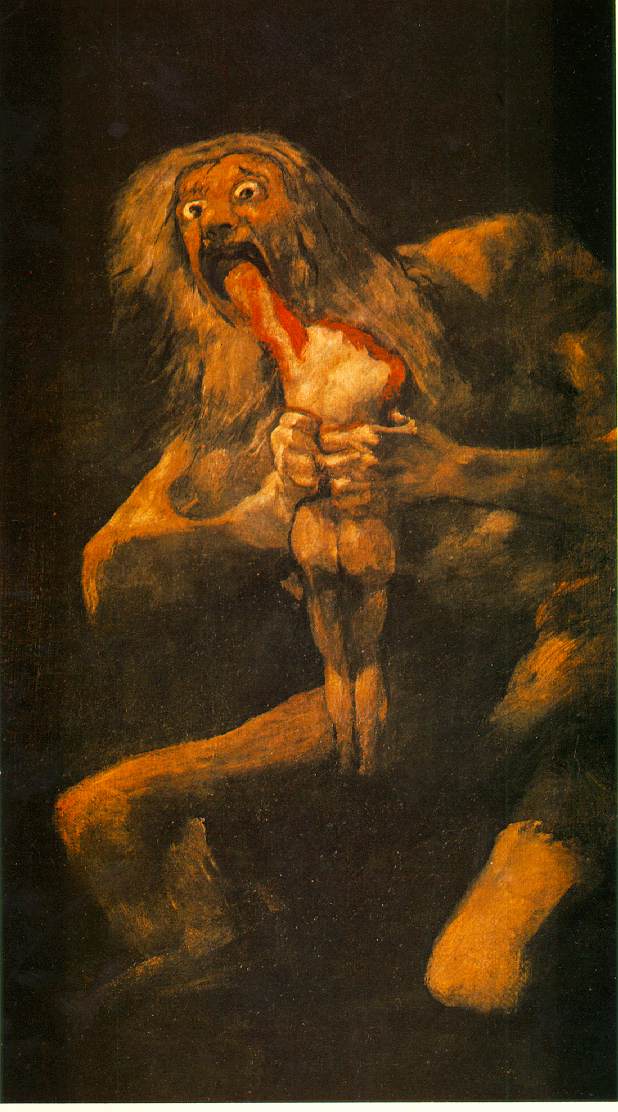
The God of Bergman (one of the reasons he eventually began to alternate between atheism and agnosticism) and of people who find Leaving Las Vegas to be a moral and spiritual failure of a film seems to me NOT to be the vision of the Ancient of Days of Daniel or Revelation that causes one to fall to hands and knees in fear and awe, but some wild-eyed, crazed god as painted in Goya’s Saturn Devouring One of His Sons. A god who hungrily devours humanity in its weakness, who sees us in our brokenness and desires to tear us limb from limb for his own sport. I’ve never seen Satan in Goya’s Saturn as other’s have, perhaps because I think we are utterly clueless as to the what/why of Satan’s desires.


Perhaps I consider Leaving Las Vegas a life-affirming film because in the end, Sera chooses to give whatever she can to Ben even if she doesn’t know how long or how capable he is of accepting her gift. Not many of us would ever be capable of that, and perhaps only a woman as broken in so many ways as Sera is could do so, though what is probably crucial in her gift is that she knows she’s broken, and most of the rest of us would never chalk up to that. In Ben’s acceptance, he affirms her own humanity and grants her participation in what it means to be a person and not a sexual object. But maybe my interpretation is skewed since I’m also someone who hears the voice of God as lover in the lyrics of “Come Rain or Come Shine,” (music by Harold Arlen, lyrics by Johnny Mercer, 1946).

I’m gonna love you like nobody’s loved you, come rain or come shine
High as a mountain and deep as a river, come rain or come shine
I guess when you met me, it was just one of those things
But don’t ever bet me, cause I’m gonna be true if you let me

You’re gonna love me like nobody’s loved me, come rain or come shine
Happy together, unhappy together and won’t it be fine?
Days may be cloudy or sunny
We’re in or we’re out of the money

But I’m with you always, I’m with you rain or shine

Sunday, February 25, 2007

Opera Productions: When is it Gilding the Lily? Or the Opposite?

Julie Taymor’s The Magic Flute (shown on PBS’s Great Performances)

I had planned to blog about a guided tour of Frank Lloyd Wright’s Unity Temple (thank you Dawn for the invite!) But a combination of my building’s elevator being down, having to walk down 17 flights of stairs, icy conditions on the roads, and ridiculous traffic on I-55 towards the west suburbs made that impossible. Instead, having turned off near Millenium Park to get out of traffic, my roommate and I went to the movie theatre and saw Reno 911!: Miami. The less said the better.

So I’ll review Julie Taymor’s production of Mozart’s The Magic Flute for the Met instead, as shown on PBS. There are really two issues here: Julie Taymor’s work and opera productions. (I’m not going to argue about whether The Magic Flute is actually an opera or not - it's technically Singspiel.) I’ll start with the latter and then get into the former.

Opera productions can of course be elaborate recreations of the original setting of the opera or what the original sets may have looked like or they can be stark and minimalist. The best (most appropriate?) I’ve ever seen is Berg’s Wozzeck (unfortunately I’ve long since forgotten which production it was, watched as it was on video in one of those awful cubicles in a university library). The worst was the recent production of Mozart’s Don Giovanni at Lyric Opera of Chicago. It took place outside of a building in Sante Fe that had only one door and no windows and at the climactic moment our Don (Bryn Terfel) supped on a huge wooden table outdoors with only a plate, a cup, and a few utensils. It was also hopelessly out of balance due to the presence of Terfel – Leporello was turned into a buffoon.

There have been a few silly ones: Wagner’s Parsifal, designed as if “a railroad runs through it.” Coincidentally, Parsifal was the opera I arranged for my classmates and myself to attend our first year of grad school. Don’t ever ever choose Wagner for a person’s introduction to opera. But I’ve also seen a number of elaborate, traditional sets, my favorite being Houston Grand Opera’s production of Verdi’s Aida performed in the late nineties.

A note: I’m not complaining about Lyric Opera of Chicago as it has provided three of my top five live opera experiences: Renee Fleming in Massenet’s Thais (Thomas Hampson as Athanael) with her beautiful pianissimo completely clear and lyrical; Olga Borodina in Saint-Saens’ Samson et Dalila (the recording with her and Placido Domingo is a must-have); and Act IV of The Marriage of Figaro, in a perfect moonlit garden with glowing lamps and Count Almaviva singing "Contessa, perdono."

There have been a number of notable productions of The Magic Flute: Bergman’s 1975 filmed version sung in Swedish; a performance with Kathleen Battle aired on PBS, and (not a version) but any performance that has Kiri Te Kanawa. Taymor’s version is “designed for children,” although it’s hard for me to imagine The Magic Flute being inappropriate for kids (too many Freemason references?). As a result - this is criticism number one – the opera has been abbreviated (to 100 minutes! And in English!) and arias have been cut. The most disastrous is the elimination of Pamina's “Ach, ich fuhl’s.” Papageno (Nathan Gunn) is played for the usual jokes but Pamina (Ying Huang) has had her part so curtailed that one can't tell that her story is the heart of the opera. As to the famous "Der Holle Roche kocht in meinem Herzen," the Queen of the Night (Erika Miklosa) is as awful as I’ve ever heard.

Some of the designs also bear an unfortunate resemblance to the set and costume designs of The Cell, that awful movie with Jennifer Lopez and Vincent D’Onofrio. I have never seen so many triangles and pyramids in a small space in my life. The dancing bears are beyond obnoxious, but I’m also slightly beyond childhood. While some I'm sure enjoy the blending of Japanese theatre, Indonesian puppetry, Masonic symbols and some sort of strange numerology - I was told by a friend that those are references to Kabbalah - I found it produced a disjointed effect, not universal appeal or mystery or the ultimate success of the Enlightenment (!). But there are some magical features, like the flying spirits and the movable masks of the muses. Frequently the sets change like a kaleidoscope. Especially charming is the hypnotic effect of Papageno's bells on all who hear them particularly the rolly-polly Monostatos. There are even women in pointe shoes when Papageno is dreaming of his Papagena and several birds walk around with stork-like legs, though it also reminds of the unfortunate way pointe was used in Hollywood movies of the 30’s and 40’s – not as an expressive medium but as tricks.

Interlude: The ballet sequences of The Goldwyn Follies (1938) were choreographed by George Balanchine, part of his Broadway and Hollywood stage in the late 30’s and early 40’s. It features his second wife, Vera Zorina, in a famous water nymph ballet: she comes out of a pool of water with her swimsuit clinging to her skin. But the best part of this largely forgettable movie is the solo danced by the firecracker ballerina Marie-Jeanne. She was the original lead in both Concerto Barocco and Ballet Imperial (both choreographed by Balanchine in the early 40’s) and like so many of his lead ballerinas, for a time they were romantically involved. In this brief part she shows the explosive jumps, speed, athleticism, and rubato that originally characterized those major roles in the Balanchine canon; in the 60’s Suzanne Farrell would redefine both of these roles with her long-legged lyricism. As far as I know, this is the only footage of her dancing that is commercially available; all else is tucked away in public or university libraries.

Back to Taymor. I suspect she may not do her best work when in collaboration with great material from another great artist. Her own vision either seems to become diluted as in Frida, or require distortions of the original material, as in this production. (Frida looks like a Mexican tourist brochure and features bad casting except for Alfred Molina as Diego Rivera.) However, she shows real vision and originality with weak material like Shakespeare’s Titus Andronicus and Disney’s The Lion King.

In the end, I don’t like her version of The Magic Flute because it conceals and cuts Mozart’s work - the morality in it is completely loss somewhere between the all-seeing Eye, samurai stances, and kitschy feathered flamingos. I don't mind when the letter isn't followed, but the spirit was also thrown out in this one too, and Taymor's vision strikes me as more confused than Mozart's. It’s an elevated version of dumbed-down musical theater and since I think audiences have been dumbed-down quite enough I’d prefer for Mozart’s material not to be used. Ms. Taymor's work can be more focused and powerful than this and I don’t really think that children can’t handle exposure to the German language or need to be distracted by eye candy to sit through opera. Nevertheless, I can appreciate the strong visual impact this work must have when seen live.

Three facts that aren't really relevant to this discussion other than perhaps showing that I'm a snob: 1) Susan Stroman is not a great choreographer or stager; she dumps every theatrical conceit and clichĂ© of the past 50 years into a pot and then spoon-feeds it to audiences who, because they can easily follow along with what’s going on thanks to its tired familiarity, think “Finally! Art I can understand!” 2) Bob Fosse is not a great American choreographer; he keeps the body completely turned in so that the only movement can occur in the pelvis, thus reducing all dance movement to the vulgar and sexualized. 3) Just throwing this out there, but I also hate most of Andrew Lloyd Webber’s music. And you and your little dog too.

Saturday, February 24, 2007

Rare Balanchine and the Suzanne Farrell Ballet


I dance for God. - Suzanne Farrell

For twenty years Suzanne Farrell was the muse of George Balanchine, the Dulcinea to his Don Quixote. (A brief biography of her, a 1990 interview, and photos can be found here.) She retired from performing ten years before I became interested in ballet, but in my readings and viewings she stood out as a central figure in the ballet boom. My ballet interest began with Nureyev and moved on towards the other great male Russian defector: Baryshnikov. It was while watching The Turning Point, an otherwise hopelessly soap opera-derived movie whose only merit is that it contains some great recordings of dance, that I first saw Suzanne Farrell move. And she moved like no one else. Her silhouette was distinctively different from other ballerinas, with her wider than normal - for a ballerina - hips and full thighs, but it's her quality of movement and musicality that are so striking. Joan Acocella described it in an interview a few years ago. Within her dancing is a complete mental, emotional, and physical absorption and commitment to the moment. Several writers commented that when she danced, she sometimes seemed to be having a religious experience; more than one compared her to St. Teresa of Avila for her nun-like purity that could transform into ecstasy while dancing a ballet like Concerto Barocco or Mozartiana. For the devoutly Catholic Ms. Farrell, worshipping God and dancing are probably the same activity.

She also stood out for her self-abnegation to George Balanchine's vision and her willingness to be his muse, to mold herself to his vision of a ballerina and of the dance. She saw herself and "Mr. B" as soulmates and believed that God destined them to be together in art; he seems to have felt similarly, calling her "the other half of my apple." That she also saw him as a God figure, instrumental to achieving transcendence through art, seems unmistakable. This despite his romantic pursuit of her, nevermind their 41-year difference in age or that he was married to his fourth wife during their five-year romantic involvement. They were never physical lovers; for her, spiritual consummation through art, through what happened in the studio and on the stage, was what was most important. The greatest use of the body was as an instrument of art in dance, not sex. She has continued in her devotion to her mentor, founding the Suzanne Farrell Ballet at the Kennedy Center in 1999 and dedicating her company to the preservation of Balanchine's choreography. As Laura Jacobs once wrote, "[Farrell] was never [Balanchine's] wife during his lifetime, but now she is the wife of his nights."

Luckily for you and me, last night the Suzanne Farrell Ballet gave a free, brief performance of rarely seen Balanchine choreography that was also webcast and archived! Watch it here (February 23, 2007).

The ballet excerpts performed are (program notes courtesy of posters on Ballet Talk):
Adagio from Concierto di Mozart (Second movement of Violin Concerto in A, K. 219 by Mozart)
performed by Ashley Hubbard and Matthew Prescott

Contrapuntal Blues Pas de deux from Clarinade (excerpt: Derivations for Clarinet and Jazz Band by Morton Gould)
performed by Elisabeth Holowchuk and Benjamin Lester; the female part was choreographed for Farrell in 1964.

Glinka Pas de deux Brillante, a section of Divertimento Brillante (themes from Bellini's La Sonnambula by Glinka)
performed by Bonnie Pickard and Neil Marshall

Variations for Orchestra (by Stravinsky)
performed by Shannon Parsley; this part was choreographed for Farrell in 1966 and revived for her in 1982.

Pas Classique Espanol Divertissements from Balanchine's Don Quixote (by N. Nabokov)
performed by:
Trio Gina Artese, Kristen Gallagher and Sara Ivan
Duet Elisabeth Holowchuk and Lisa Reneau
Solo Shannon Parsley
Pas de deux Natalia Magnicaballi and Kirk Henning

Ms. Farrell really deserves her own post - actually, several - from me, but I wanted to write this little bit and inform about the webcast. Read her autobiography, Holding on to the Air, or watch Elusive Muse for incredible footage of her dancing. She also, dancing-wise, is featured prominently in the PBS documentary Balanchine.

Thursday, February 22, 2007

Do You Know What It Means To Miss New Orleans

A Lenten Reflection

I apologize for the delay in posting – personal and professional business has been intense in the past two months! I have been meaning to continue the discussion in the post below, but have been too busy to organize the thoughts for it. Writing a dissertation is like entering into a huge fog from which you are not sure you will emerge (it never lifts – it’s waiting to envelop every unsuspecting person who goes to grad school). Excitatory and inhibitory neurotransmission between the prefrontal cortex and basolateral amygdala in response to cues haunts my life right now, and I need positive thoughts and good memories at this time. So instead of a ridiculously long post on the Catholic experience in 2007, I’ll stick my head out a bit and post a reflection on my hometown.

Recently, PBS’ American Experience aired a two hour documentary on New Orleans. Louis Armstrong singing the above title has me thinking. I believe all people remember their childhood in a certain visceral way: tastes, smells, colors, sounds. For me, New Orleans is in pinkish corals, golden yellows, ecru, pale blues, and the dark greens of trees and brownish-grays of moss. It smells like either coffee or a certain staleness that I would realize in adolescence was a sometimes (depending on which way the wind was blowing) pungent combination of cigarette smoke, stale beer, waste, and the accumulation of the latter that’s in the slow-moving, murky Mississippi River that runs through the city.

My parents are from towns north of Lafayette in Acadiana so I never associated gumbo, etouffee or boiled crawfish (certainly not boudin or rice dressing!) with New Orleans food. My parents’ heritage resides in Cajun territory; my sister and I were born in the Creole city. New Orleans’ cuisine was shrimp bisque, bread pudding with whiskey or rum sauce, turtle soup, these wonderful shrimp toast appetizers that a neighbor made, beignets at CafĂ© du Monde – none of which my mom cooked for us. And of course po’boys. And the sounds – any brass band, actually any brass instrument, draws me back to New Orleans. I associate hot and humid with New Orleans; the weather-induced slowness is New Orleans too. There’s even a ray of sunlight from a certain angle – about 40 degrees from vertical, with a pale yellow light that becomes golden the closer it gets to the ground – that is New Orleans. So is sitting on the wet green grass under huge cypresses and live oaks covered in moss with mosquito-larva filled water slowly moving by (especially when in City Park, with the Museum of Art only a few paces away).

And then there are the churches. New Orleans is a Catholic city, and has historically fancied herself a European city. Thus, the churches (and there were so many of them in my childhood) are ornate in French or Italian baroque style, statues and paintings larger than life and in Technicolor with gilding everywhere. My sister used to fear a large statue of St. Lucy, holding her huge green eyes on a platter in front of her. There was St. Anne’s Church, where my mom often went to daily Mass and as she’d kneel and pray, I would play with an extra rosary she had that had a strange blue iridescence. Then, my favorite part: the Stations of the Cross, meditated on while crawling up steps on one’s knees. I didn’t do that bit, so eager to reach the Resurrection (at the top of the steps one walked out onto the roof, in the full blaze of that New Orleans’ sun) and then walk back into the darkness of an alcove where Mother Mary was, with votive candles surrounded by blue glass at her feet.

At least, that’s the way I remember it, having left the New Orleans of my childhood at the age of six. We moved back there when I was nearly ten (my parents and sister still live there), but now we lived elsewhere in the metro area and I was older and wiser and the ability of sensory details to make deep imprints had been dampened by the skill of living inside my own head and having what I imagine were heavy intellectual discussions with myself.

But let me assure you, if you haven’t experienced it yourself: nothing is as sharp of a contrast as going from the Carnival season in New Orleans to Lent in New Orleans, with all the repentance hanging heavy in the air. From Mardi Gras to Ash Wednesday. For me as a child, it was awful. From Christmas we celebrated straight through ‘til Mardi Gras. I actually think the holiday season in New Orleans may stretch from Halloween to Mardi Gras, and I’m not talking the commercial buying and selling. It’s parties and celebrations, as if we were medieval field workers who just finished seeding the soil for the following spring, and could have festivity after festivity. The week of the Passion was almost a release – finally, something was happening again! Anything was better than the nothingness of Lent (besides mandatory seafood dinners, of course).

That’s one of the many things growing up in New Orleans taught me about Catholic life: to be IN Lent is to be in a certain kind of nothingness, realizing that you don’t deserve what’s good, and that to be alone, truly alone, is the most terrible of things. We are strengthened in community, and sometimes the whole community needs to repent, each on their own and yet together at the same time. As one commentator in the PBS documentary said, in New Orleans everyone is different, but everyone moves to the same rhythm, partaking from the same culture that has been able to incorporate French and Spanish upperclassmen, free blacks, Native Americans, WASPs, German, Irish, and Italian immigrants, and just about anyone else who wanted to add a little to the mix. There’s something here about being Catholic too. But for now, I’d prefer to remember what this time felt like for me as a child, to recover just a bit of the emotional impact the sensory details had on me, and the sense of darkness of this season.